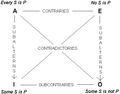
 On 28 October, while preparing a handout for my Logic students, I discovered a square of opposition for propositional logic. (This has nothing to do with the discovery I made while riding my bike in Ennis on 31 October. That concerned the square of opposition for syllogistic logic.) I had never seen a square of opposition for propositional logic and wasn't sure what to make of it. Yesterday, while running, I thought about the matter further and discovered a second square of opposition for propositional logic, which I drew at my desk while still dripping sweat (so as not to forget it). This second discovery was discouraging, actually, because it suggested that there may be many squares rather than one unique square. I drew both squares on a sheet of paper and filed it away in my Logic notebook so that I can show future students.
This morning, while searching JSTOR, I found a 37-year-old essay by Colwyn Williamson in the Notre Dame Journal of Formal Logic entitled "Squares of Opposition: Comparisons Between Syllogistic and Propositional Logic." You guessed it: Williamson discovered the squares (both of them!) long before I did. I know that I discovered them independently, so I take pride in that.
In case you're wondering, the first square I discovered goes like this. In the upper left of the square is the proposition "p & q" (which says that both p and q are true). In the upper right is "˜p & ˜q" (both are false). In the lower left is "p v q" (at least one is true). In the lower right is "˜p v ˜q" (at least one is false). If you construct a truth table for all four of these propositions, you'll see that the two propositions across the top are contraries, the two across the bottom subcontraries, the two at each diagonal contradictories, and the two on each side (right and left) subalterns.
 Keith Burgess-Jackson, J.D., Ph.D.