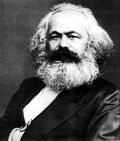
 Marx views the history of philosophy in a different perspective from that which is customary in universities and colleges in this country, and conversely the picture of philosophical development presented there is such that it is not easy to fit Marx into it. He is explicitly opposed to most of the tendencies which have prevailed in academic philosophy, whether ancient or modern. He is not content that philosophy should serve the contemplative life, seeking and finding its culmination in the vision of metaphysical truth; nor is he willing to resolve it into a critique of knowledge, if the critique is to be regarded as an activity worth while for its own sake. He comes to philosophy as a man of the world, an activist, expecting of it that it should coordinate and clarify what science and common experience have taught him about the world, and point the way to action for the betterment of human life. Neither metaphysical speculation nor critical analysis is worth much in his eyes if it does not contribute to this end. Nor does he consider it a virtue to regard all philosophical questions as open questions. If philosophy is to be of any use, if it is to have any impact on life and action, it is important to have the right philosophy, and it is not impossible to know what this is. Like Spinoza, Marx 'does not think he has invented the best philosophy, but knows he has found the true one'. He knows that there is no God, and sees no use in being indecisive and agnostic about this. He knows that the real world is the material world, and that there is nothing in that world which is in principle unknowable to us; so why should he have any truck with idealism or phenomenalism or any other philosophy which denies or doubts the truth or obscures it with useless subtleties? Such is his way with rival philosophies, and such has been the Marxist way ever since.
(H. A. Hodges, "The Thought of Karl Marx," in Christian Faith and Communist Faith: A Series of Studies by Members of the Anglican Communion, ed. D. M. MacKinnon [London: Macmillan & Company, 1953], 3-20, at 7)
Note from KBJ: It's mind-boggling that some contemporary philosophers consider Marx a philosopher. Philosophy is contemplative, not active. Its aim is to understand the world, not change it. To a philosopher, all questions are open questions. Dogmatism is the antithesis of philosophy. Philosophers don't "know" that there is no God; they analyze the concept of God and ask such questions as (1) whether a being of that sort is compatible with evil, (2) what would constitute evidence for and against the existence of God, (3) what would make belief in God reasonable, and (4) whether belief in God (i.e., theism) is compatible with science. Marx was undoubtedly a deep thinker (though deeply mistaken about a great many things), but he was no philosopher.
 Keith Burgess-Jackson, J.D., Ph.D.