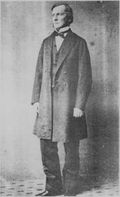
 As indicated above, Boole was an accomplished mathematical analyst who thought he knew Aristotle’s logic thoroughly and who found Aristotle’s logic to be flawless as far as it went. However, as we will soon see in detail, Boole did not think that Aristotle’s logic went deep enough or wide enough. One of the goals of Boole’s work was to preserve the results that Aristotle had achieved while at the same time contributing in two contrasting ways to the further development of the project that Aristotle had begun. Boole wanted to simplify Aristotle’s system in one respect while making it more complicated in other respects. Boole wanted, on the one hand, to unify Aristotle’s logic and to provide it with an algebraic-mathematical foundation. Early in his logical work he said that logic should not be associated with philosophy but with mathematics (Boole 1847, p. 13). In Laws of Thought he expressed this conviction about logic: ‘it is . . . certain that its ultimate forms and processes are mathematical’ (1854, p. 12). On the other hand, Boole wanted to broaden Aristotle’s logic by expanding the range of propositions whose forms could be adequately represented and by expanding the basic inferential transformations so that the derivations familiar to Boole from mathematics, such as substitution of equals for equals and applying the same operation to both sides of an equation, could be carried over to ordinary syllogistic argumentation.
Boole may have seen the relation of his mathematical logic to Aristotle’s syllogistic logic somewhat as Einstein was to see the relation of his relativistic mechanics to Newton’s classical mechanics. In both cases, roughly speaking, the older theory provided a paradigm and a class of accepted results for the new, and the older results were to become either approximations or limiting cases for results in the newer theory. In both cases, the later theorist accepted what he took to be the goals of the earlier theorist, but then went on to produce a new theory that he took to better fulfill those goals. Demopoulos (pers. comm.) suggests that Boole may have thought the relation of his logic to Aristotle’s to be like the relation of Newton’s theory of gravity to the Keplerian theory of planetary motion based on Kepler’s three laws. In each of the two analogies the newer theory was thought of as a broadening of the older. Accepting the Newton/Kepler analogy would suggest that Boole’s theory explains or gives the reasons for Aristotle’s logical results while excluding the possibility that Boole may have thought that Aristotle had been deficient and wrong, not just partial or incomplete. From Newton’s viewpoint Kepler’s theory gave correct descriptions of the motions of the planets but without an explanation; Newton explained why Kepler was right.
(John Corcoran, "Aristotle's Prior Analytics and Boole's Laws of Thought," History and Philosophy of Logic 24 [December 2003]: 261-88, at 270)
 Keith Burgess-Jackson, J.D., Ph.D.