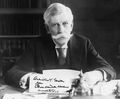
 At present, in very many cases, if we want to know why a rule of law has taken its particular shape, and more or less if we want to know why it exists at all, we go to tradition. We follow it into the Year Books, and perhaps beyond them to the customs of the Salian Franks, and somewhere in the past, in the German forests, in the needs of Norman kings, in the assumptions of a dominant class, in the absence of generalized ideas, we find out the practical motive for what now best is justified by the mere fact of its acceptance and that men are accustomed to it. The rational study of law is still to a large extent the study of history. History must be a part of the study, because without it we cannot know the precise scope of rules which it is our business to know. It is a part of the rational study, because it is the first step toward an enlightened scepticism, that is, toward a deliberate reconsideration of the worth of those rules. When you get the dragon out of his cave on to the plain and in the daylight, you can count his teeth and claws, and see just what is his strength. But to get him out is only the first step. The next is either to kill him, or to tame him and make him a useful animal. For the rational study of the law the black-letter man may be the man of the present, but the man of the future is the man of statistics and the master of economics. It is revolting to have no better reason for a rule of law than that so it was laid down in the time of Henry IV. It is still more revolting if the grounds upon which it was laid down have vanished long since, and the rule simply persists from blind imitation of the past. I am thinking of the technical rule as to trespass ab initio, as it is called, which I attempted to explain in a recent Massachusetts case.
Let me take an illustration, which can be stated in a few words, to show how the social end which is aimed at by a rule of law is obscured and only partially attained in consequence of the fact that the rule owes its form to a gradual historical development, instead of being reshaped as a whole, with conscious articulate reference to the end in view. We think it desirable to prevent one man's property being misappropriated by another, and so we make larceny a crime. The evil is the same whether the misappropriation is made by a man into whose hands the owner has put the property, or by one who wrongfully takes it away. But primitive law in its weakness did not get much beyond an effort to prevent violence, and very naturally made a wrongful taking, a trespass, part of its definition of the crime. In modern times the judges enlarged the definition a little by holding that, if the wrongdoer gets possession by a trick or device, the crime is committed. This really was giving up the requirement of a trespass, and it would have been more logical, as well as truer to the present object of the law, to abandon the requirement altogether. That, however, would have seemed too bold, and was left to statute. Statutes were passed making embezzlement a crime. But the force of tradition caused the crime of embezzlement to be regarded as so far distinct from larceny that to this day, in some jurisdictions at least, a slip corner is kept open for thieves to contend, if indicted for larceny, that they should have been indicted for embezzlement, and if indicted for embezzlement, that they should have been indicted for larceny, and to escape on that ground.
(Oliver Wendell Holmes, "The Path of the Law," Harvard Law Review 10 [25 March 1897]: 457-78, at 469-70)
Note from KBJ: This is a clear statement of the difference between legal conservatism and legal progressivism (which should not be confused with political conservatism and political progressivism). What Holmes doesn't realize is that the mere fact that a legal rule has stood the test of time demonstrates its usefulness, and therefore its rationality. Holmes—a legal progressive—would determine afresh whether a given rule is worth retaining. He would accord no presumption to it on the basis of its longevity. I'm sorry, but I trust generations of lawyers and judges far more than I trust any one person, even someone as brilliant as Oliver Wendell Holmes. Tradition wouldn't be tradition if it did not embody reason. This doesn't mean tradition may not be modified or, in a given case, abolished; it means there is a presumption—perhaps a strong one—in its favor. The presumption must be rebutted by the reformer, i.e., the burden of proof is borne by the reformer.
Holmes's illustration is revealing. He would assimilate larceny and embezzlement, on the ground that the outcome (namely, misappropriation of property) is the same. This ignores a relevant difference between the crimes. Larceny involves a trespass. The property is taken from the owner's possession. Embezzlement does not involve a trespass. The property is lawfully in the possession of the embezzler at the time it is misappropriated. Why does this matter? Because when property is taken from one's possession, there is likely to be an altercation. The law of larceny was designed to prevent altercations as well as misappropriations. It protects two interests: the interest in bodily integrity and the interest in property. Embezzlement is designed to prevent only misappropriations. Since the interests being protected are different, there should be different crimes (and presumably different punishments). Holmes sees only the misappropriation; he is blind to the trespass.
Some people, such as James Rachels (1941-2003) and Peter Singer, say that there is no morally relevant difference between acting and omitting. (They reject what is called [by Jonathan Glover] the Acts and Omissions Doctrine.) Other things being equal (they say), killing someone is no worse than allowing someone to die (put differently, allowing someone to die is just as bad as killing someone). The ground for this belief is that in both cases, someone ends up dead. That may be true, but it doesn't mean there are no morally relevant differences between the cases! Consequentialists such as Holmes, Rachels, and Singer care only about results (in Holmes's words, "the social end which is aimed at"). Most of us care about more than results. To use an accounting metaphor, consequentialists care only about the bottom line (i.e., the sum at the bottom of the page). Most of us care about the lines above the bottom line as well as the bottom line. In other words, we care about how the bottom line came to be what it is. We care about paths, not just destinations. We care about processes, not just outcomes. We care about means, not just ends. To a consequentialist, the end justifies the means.
 Keith Burgess-Jackson, J.D., Ph.D.