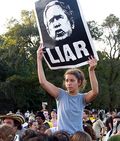
 It happened. During the Bush administration, critics called George W. Bush a liar so often and with such vehemence that people have come to think of a lie as a mere utterance of a falsehood. In fact, a lie is a very special utterance of a falsehood. To lie, one must do all of the following: (1) say something false; (2) know that it is false at the time of utterance; and (3) say it in order to deceive. It was said that President Bush lied about Iraq having weapons of mass destruction. What he said may have been false, but there is no evidence that he lied.
The other day, while listening to talk radio on the way home from school, I heard someone say that so-and-so "knew that he was lying." Is it possible to lie without knowing it? How could it be, when the very concept of a lie requires knowledge that what one says is false? I think what has happened is that the concept of a lie has been inflated. To some people, a lie is merely an utterance of a falsehood (or perhaps the utterance of a falsehood by someone one dislikes). So now we have to distinguish between two types of lie: (1) those in which the liar knows that he or she is lying (as in the radio broadcast); and (2) those in which the liar doesn't know that he or she is lying.
May I make a suggestion? Let's stop inflating the concept. A lie is a special utterance of a falsehood. It is possible to say something false without lying. Since being a liar is a bad thing, morally, shouldn't we give others the benefit of the doubt? Shouldn't we assume, in other words, that while what was said is false, it wasn't done knowingly or with intent to deceive? And even if it's not the case that we should give everyone the benefit of the doubt, shouldn't we give our president the benefit of the doubt? Sadly, progressives gave President Bush the detriment of the doubt. This is disrespectful and reflects poorly on them as people.
 Keith Burgess-Jackson, J.D., Ph.D.