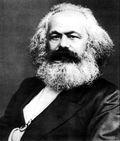
 Men's actions, their social relations, their institutions, and their fate are shaped by their relation to their material environment; that is true. But it is not the given environment as such, e.g. climate, geographical situation, etc., which has this effect. It is the technical equipment with which a given society sets about obtaining its living in its given situation. Development of techniques of production leads to division of labour, and so to specialisation, and the more so the more developed the techniques are. Specialisation leads to the formation of occupational groups among men, since those who have the same skills will tend to get the same reward for their labour, to live in the same conditions, and to have similar interests. It further happens that some of these groups are exploited by others. Primitive society, according to Marx, was Communist, but the development of complex techniques led to the inevitable break-up of that system. Those who were in possession of a skill which was essential to social prosperity exploited their position and engrossed more than their share of the common store. As different kinds of capital became needful, e.g. land, money, machinery, those who could get possession of these were able to exploit the rest of the community. Hence came what is the one fundamental division in society, the division between the class who own the means of production and distribution and the class who do not. There are, of course, numerous subdivisions in each of these two sections of society, but there is always the overall division into the two camps. They are always in conflict, though not always in open war; and at bottom all recorded history is the history of class conflicts.
Law and government, on this view, are devices by which the ruling class keep their position safe. They pretend, of course, to be based on high principles of justice and the like; but that is a mere façade. Behind these alleged principles there is always the reality of class domination. Of course, in its own interests a ruling class must give its subjects conditions which they will accept more or less contentedly. A prosperous ruling class may give the whole community a degree of justice and well-being, peace and order. While it does this, it is safe. But a time always comes when the ruling class cannot keep its position without a fall in the standard of living of many of its subjects. Then there are the materials for a revolt. But again, there will not be a successful revolt until there is a change in the technical equipment of that society, so that a new class of people come to the top, who are in possession of the new technique and of the kind of capital which its application requires. These are the revolutionary class, who will oust the old ruling groups. The revolutionary class always pose as champions of the people at large, and get popular support; but in the event they merely substitute their own domination for that of their predecessors. Such is the dynamic of historical change.
Such it has been, at least, until now; but Marx gives reasons for thinking that the pattern will not repeat itself for ever. He analyses at length the stages by which the feudal aristocracy, the mediaeval ruling class, has been replaced by the present ruling class, the capitalist bourgeoisie, and how the introduction of machinery and factory production has already called into being another new class, the propertyless industrial workers, or proletariat. These are the new revolutionary class. Living together in towns and workshops, endowed with technical education (which they must be given in order to work the machines), capable therefore of combination and collective action, they will inevitably expropriate their expropriators and take power themselves. And in so doing they will really be what previous revolutionary classes have pretended to be, the saviours of society. Previous revolutions have merely substituted one ruling class for another. The proletarian revolution will be different; it will put an end to exploitation and ruling classes altogether. For the effect of capitalism is gradually to turn everyone who is not a capitalist into a proletarian. The proletariat, then, is not, like previous revolutionary classes, a minority, but the great mass of the people, and the claim to represent the public interest is in its case justified. When the capitalist minority is abolished, power will rest not with a new minority group, but with the people as a whole. Since the people will then own their industries and run them for the general good, there will be no exploitation and no class divisions, but a classless society. And, since government and the state are merely devices for class domination, a classless society will have no use for them, and the state will of its own accord wither away. There will of course be plenty of organisation and administration; but there will be no more coercive authority, no more armed forces and police. Education and public opinion will create and maintain the necessary public spirit, and men will compete no longer in pursuit of private advantage, but in the service of the community.
There is a vast sweep in Marx's historical view, whether he is describing and explaining the past, analysing the present, or predicting the future. What is to be noticed in all this, however, is the way in which the materialist conception of history proves itself capable of sustaining so great a structure. The whole vast synthesis is based on the one fundamental insight into the class character of social conflicts, and the dependence of class relationships upon methods of production and distribution. It is because of the nature of these methods in the past that class division and class struggle have hitherto been perpetual. It is because of the form which capitalist production is now taking, that the conditions for the abolition of class divisions are being created. Not the working out of a divine purpose or a metaphysical principle, but the working of a fundamental sociological law is the ground of our confidence in the future.
(H. A. Hodges, "The Thought of Karl Marx," in Christian Faith and Communist Faith: A Series of Studies by Members of the Anglican Communion, ed. D. M. MacKinnon [London: Macmillan & Company, 1953], 3-20, at 13-5)
Note from KBJ: Marxism is political philosophy for the cynical. Libertarianism (think Robert Nozick) is political philosophy for the greedy. Egalitarianism (think John Rawls) is political philosophy for the envious. Conservatism (think Edmund Burke) is political philosophy for the pessimistic. Utilitarianism (think Jeremy Bentham) is political philosophy for the optimistic. Yes, I am saying that one's personality determines, or at least strongly influences, one's political philosophy. So sue me.
 Keith Burgess-Jackson, J.D., Ph.D.