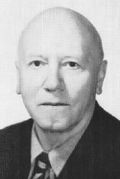
 As a child I was brought up, both at home and at school, in an atmosphere in which Christianity was explicitly taken for granted as literally true. We were very definitely Protestant; but beyond that there was no strong sectarian bias. I was taught to say my prayers when I got up in the morning and when I went to bed at night. I continued to do this with fair conviction for many years, much as I brushed my teeth, and (it must be confessed) with considerably greater regularity. Hell and the Devil were not much mentioned; but they were there in the background, and I, with my natural tendency to be moved by fear rather than by hope, was much more frightened by the possibility of hell than attracted by that of heaven. I learned, however, fairly early from my father that the story of the creation in Genesis was not to be taken literally, and I learned somewhat later from him that the reliability of the Gospels on matters of detail had not survived the criticism of biblical scholars.
There the matter rested until I was about 15 or 16 years old. I was then studying natural science. At about that time the Rationalist Press Association was issuing a series of cheap reprints of writings by such men as T. H. Huxley, Tyndall, Haeckel, etc. The series included also books by sceptical scholars who were not natural scientists, e.g., Renan's Life of Jesus and Leslie Stephen's An Agnostic's Apology. I bought and read these works with avidity. At the same time I was reading with great admiration each of the successive books of social criticism and speculation, such as Anticipations and Mankind in the Making, which came from the pen of H. G. Wells. These moved me in the same general direction. My Christianity, which had probably been wearing pretty thin, collapsed and was replaced by what I should now regard as a rather smug and thin rationalism (in the popular sense of that word), based on natural science.
There was no kind of worry or regret over this; on the contrary I got a good deal of 'kick' out of feeling myself wiser than the deluded old fogies who were my elders and thought themselves my betters. I imagine that a similar phase, varying in its details from one generation to another, has been gone through by clever adolescents since the dawn of history. A sensible person, who has not forgotten his youth, will greet successive manifestations of this process with a not unsympathetic smile, which he will do well to conceal from his young friends. My father behaved with admirable good sense; and I had the decency not to do or say anything that might hurt Aunt Leah, and the prudence not to throw my weight about in presence of Uncle Edwin and Aunt Harriet. When I came to Cambridge I met many undergraduates who were passing through the same phase and deriving a good deal of satisfaction from it, and a certain number of dons who had never grown up and got past it.
When I was at school I used to have long arguments with a boy, C. H. Rutherford, who was moving in the opposite direction to me, viz., toward Roman Catholicism. Rutherford was highly intelligent, and one of the wittiest and most entertaining persons whom I have known. He went up to Cambridge a year before me, entered the Roman Church while there, became a schoolmaster at Downside, and was known to generations of boys there as Father Anselm. We made no impression on each other by our arguments, but he did give me a knowledge of the Roman Catholic point of view and a respect for it which I had previously had no chance to acquire. If per impossibile I were to become a Christian, I think I should become a Roman Catholic.
I have stated my attitude toward religion in general and Christianity in particular in my published writings, and there is no need to restate it here. The only one of the great religions which makes any appeal to me is Buddhism; and that, as I understand it, is rather a philosophy of the world, and a way of life for the élite founded upon it, than a religion in the ordinary sense of the word.
(C. D. Broad, "Autobiography," in The Philosophy of C. D. Broad, ed. Paul Arthur Schilpp, The Library of Living Philosophers, vol. 10 [New York: Tudor Publishing Company, 1959], 1-68, at 43-4 [italics in original] [essay written in 1954])
 Keith Burgess-Jackson, J.D., Ph.D.