 In the same year, 1837, and in the midst of these occupations, I resumed
the Logic. I had not touched my pen on the subject for five years,
having been stopped and brought to a halt on the threshold of Induction.
I had gradually discovered that what was mainly wanting, to overcome
the difficulties of that branch of the subject, was a comprehensive,
and, at the same time, accurate view of the whole circle of physical
science, which I feared it would take me a long course of study to
acquire; since I knew not of any book, or other guide, that would spread
out before me the generalities and processes of the sciences, and I
apprehended that I should have no choice but to extract them for myself,
as I best could, from the details. Happily for me, Dr. Whewell, early
in this year, published his History of the Inductive Sciences. I read it
with eagerness, and found in it a considerable approximation to what I
wanted. Much, if not most, of the philosophy of the work appeared open
to objection; but the materials were there, for my own thoughts to work
upon: and the author had given to those materials that first degree of
elaboration, which so greatly facilitates and abridges the subsequent
labour. I had now obtained what I had been waiting for. Under the
impulse given me by the thoughts excited by Dr. Whewell, I read again
Sir J. Herschel’s Discourse on the Study of Natural Philosophy: and I
was able to measure the progress my mind had made, by the great help I
now found in this work—though I had read and even reviewed it several
years before with little profit. I now set myself vigorously to work out
the subject in thought and in writing. The time I bestowed on this had
to be stolen from occupations more urgent. I had just two months to
spare, at this period, in the intervals of writing for the Review. In
these two months I completed the first draft of about a third, the most
difficult third, of the book. What I had before written, I estimate at
another third, so that only one-third remained. What I wrote at this
time consisted of the remainder of the doctrine of Reasoning (the theory
of Trains of Reasoning, and Demonstrative Science), and the greater
part of the Book on Induction. When this was done, I had, as it seemed
to me, untied all the really hard knots, and the completion of the book
had become only a question of time. Having got thus far, I had to leave
off in order to write two articles for the next number of the Review.
When these were written, I returned to the subject, and now for the
first time fell in with Comte’s Cours de Philosophie Positive, or rather
with the two volumes of it which were all that had at that time been
published.
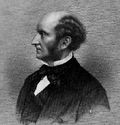
Note from KBJ: Mill was 31 years old in 1837, when he returned to his book on logic. It's interesting that he set it aside for five years while mulling over the topic of induction. I, too, have set scholarly projects aside for a while, returning to them when my thoughts crystallized. Sometimes I solve problems while running or cycling.
 Keith Burgess-Jackson, J.D., Ph.D.