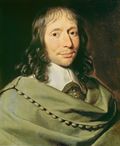
 Pascal, the important seventeenth-century mathematician and physicist,
became an adherent of the austere Jansenist group of Catholics who were
rivals of the more worldly Jesuits. Pascal held that the existence of God could
not be proved by reason. (Later, the First Vatican Council was to condemn
this opinion as a heresy.) He implicitly conflated belief in God with belief in
the Catholic religion, including its doctrine about bliss in heaven and infinite
torment in hell. So for him the only two ‘living options’, as William James
called them, were Catholicism on the one hand and atheism on the other
hand. For example, he would not think of Islam and a Muslim would not
think of Catholicism. Moreover, there are other options, though not ones that
Pascal would have considered. Nevertheless in evaluating Pascal’s argument
we must consider other options.
Still, let us for the moment pretend that Pascal’s two options are the
only ones and follow his argument which can be put simply as follows.
Pascal argued that Catholicism has a non-zero probability. He concedes that
it is possible that one might have many pleasures in our earthly life which
would be lost to us if we embraced a strict religious life. However, Pascal
points out that such happiness could only be finite. Even the smallest finite
probability of infinite torment in hell would outweigh it, since it would give
an infinitely negative ‘expected utility’ (to use a present day terminology).
The product of an infinite unhappiness with even the smallest non-zero
probability of its occurrence will still be infinite. So it is prudent to embrace
the religious life.
As I have suggested, one thing wrong with the argument is precisely in the
supposition that there are only the two options. Pascal could compare only
those options that were live for him, but options might be live for us though
not for Pascal. Furthermore Pascal makes the assumption that the only alternative
to atheism is Catholicism with its additional doctrines of heaven and
hell. These assumptions could be questioned and we could shed doubt on the
factual assumptions behind the argument.
One assumption of Pascal’s argument is of the existence of an afterlife and
of the possibility of eternal damnation if we reject the Christian religion,
perhaps even just its Catholic version. But maybe it is some other religion
that will be rewarded by God. Just as conceivable as Pascal’s assumption, as
Antony Flew has remarked, is that ‘there is a hidden God who will consign
all and only Catholics to the fate they so easily approve for others’. (Still
it might be judged much less probable than the orthodox belief—if so the
argument could perhaps be sound.) Similarly, as William James remarked,
there might be a Deity, who took ‘particular pleasure in cutting off believers
of this pattern [i.e. on the basis of Pascal’s Wager] from their infinite
reward’.
(J. J. C. Smart, "Atheism and Theism," chap. 1 in Atheism and Theism, 2d ed., by J. J. C. Smart and J. J. Haldane, Great Debates in Philosophy, ed. Ernest Sosa [Malden, MA: Blackwell Publishing, 2003], 6-75, at 47-8 [endnotes omitted; brackets in original])
Note from KBJ: The first rule of philosophy is that you be charitable toward your opponent. Smart, to his discredit, breaks this rule. He assumes, without supporting evidence, that Pascal meant to persuade the world, as opposed to a proper subset of the world. In fact, as any student of Pascal knows, the Frenchman had a narrow audience in mind for his wager: his backsliding Christian friends. These friends, Pascal knew, accepted his premises, including the partition into "Christian" (or perhaps "Catholic") and "nothing." They were gamblers, so he could count on them understanding his concepts (such as infinity) and method (probability theory), and they were driven by self-interest. It is sad that so many philosophers misunderstand Pascal's argument. In their haste to find fault with it, they misstate it. That is not fair to Pascal.
Note 2 from KBJ: Here is another way to look at it. Pascal is trying to show his backsliding Christian friends that their own beliefs and values commit them, logically, to believing in God. He is not trying to show anyone who lacks these beliefs or values that they are so committed. The irony is that Pascal was far smarter than his critics. He knew exactly what he wanted to do and he did it. Anyone can be made to look silly by having grandiose goals imputed to him or her. Suppose I purchase a Honda Accord and discover that it cannot leap logs. Is that a fault of the car? Of course not. It's a fault in me, for expecting the car to do things that its designer and manufacturer did not intend for it to do.
 Keith Burgess-Jackson, J.D., Ph.D.