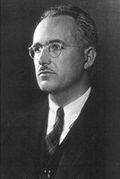
 Besides revealing the structure of our brains, science furnishes one of the most effective disciplines for improving our minds. It trains us in conserving the flow of mental current and in discriminating between emotional and intellectual processes. One of the great defects of modern education, especially of progressive education, is its diffuseness. It lacks insistence that the student learn to focus his attention in trains of thought which produce sharp, clear patterns in the brain, instead of a chaotic opening and closing of mental switches at random, governed by the feelings of the moment. Much of this fault comes from our methods of teacher training; the poorest education for an educator, it seems, is the study of education. He should first have interest in a specific discipline with which he can deeply engrave his own mental circuits.
(George R. Harrison, "Faith and the Scientist," in Atlantic Essays, ed. Samuel N. Bogorad and Cary B. Graham [Boston: D. C. Heath and Company, 1958], 295-307, at 303 [essay first published in 1953])
 Keith Burgess-Jackson, J.D., Ph.D.