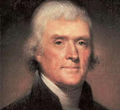
 8-21-90 I went to the UTA library this afternoon to look for history books by Page Smith. Smith, a prolific writer, has produced since 1976 a seven-volume “people’s history” of the United States; I want to cite it in the final section of Informal Logic as an example of cultural (rather than the traditional military and political) history. While in the library I came across several sets of letters and papers by eminent Americans such as Thomas Jefferson, George Mason, John Calhoun (one of which I checked out), and Woodrow Wilson. The UTA library has a good collection of such sets, which should come in handy as I gather arguments for my book revision. Despite my aim of getting home early, I sat reading a selection of Jefferson’s letters for two hours. What a brilliant mind! When people think of Jefferson, they think of the presidency, the Declaration of Independence, and perhaps, if they were taught well and have good memories, the Louisiana purchase. Little do they realize that Jefferson was a classical scholar, architect, lawyer, connoisseur of music and art, scientist, agriculturist, and philosopher. He thought less of politics than any of these fields. The man was extraordinary. I thought of John Stuart Mill [1806-1873] as I read the letters, because both men were interested in everything and had an amiable, generous disposition that comes through in their writings.
When I compare my own knowledge and accomplishments to theirs, I feel utterly inadequate, if not fraudulent. How can I hold a Ph.D. degree, which is emblematic of intellectual achievement in this day and age, when I know little or nothing of the classics of literature, the details of early or contemporary science, and much of human history? Jefferson seemed to take his learning in stride, as part of a rich, inquisitive life. In letter after letter he discoursed on such subjects as the rotation of crops, female education, the justice and legality of inheritance, George Washington’s character, Plato, Jesus, Machiavelli, wines, the University of Virginia (the ground plan of which he laid out), Greek architecture, the French people, the causes of and remedies for inequality, revolution, and drawing. He clearly loved his daughters and wanted nothing but the best for them. In one of his last letters he described and wrote an epitaph for his gravestone. If there were any chance that I could become such a wide-ranging intellect before I die, it wouldn’t be so depressing. But I know full well that from here on out I will have to specialize in order to make my way in the profession. There will be little time for remedial reading, little chance to become the Renaissance person Jefferson was. I do have one thing on Jefferson, however. As far as I know, he didn’t keep a journal. [He did, however, have a voluminous correspondence.]
 Keith Burgess-Jackson, J.D., Ph.D.