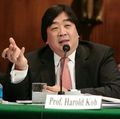
 From 1945 until 2001, the United States helped to build an international system of institutions and norms that promoted a vision of human rights, democracy, and global cooperation, which the United States saw as serving its national interest. Since 2001, we have, in a variety of ways, adopted positions which have made us a deliberate outlier from rules that we enforce on others. We have pushed for double standards. Put another way, the United States has two kinds of power, hard power (military power, armories, etc.) and soft power, which flows from our moral authority. If we squander our moral authority, then we are fighting a War on Terror based on hard power alone, which is strikingly limited in what it can do. As the war stretches on, we find that we cannot accomplish our goals without diplomacy and international law—soft power tools that were developed precisely so that countries would not have to rely exclusively on force all the time. In short, we built this system to work in our favor, and then we turned around and squandered our soft power assets, allowing our “bad exceptionalism” (propensity for double standards) to diminish our capacity for “good exceptionalism” (moral leadership on human rights).
(Harold Hongju Koh, "Can the President Be Torturer in Chief?" Indiana Law Journal 81 [fall 2006]: 1145-67, at 1153 n. 38)
 Keith Burgess-Jackson, J.D., Ph.D.