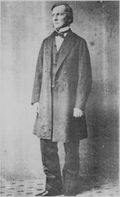
 Boole is one of the most misunderstood of the major philosophers of logic. He gets criticised for things he did not do, or did not do wrong. He never confused logic with psychology. He gets off without blame for errors and omissions he should have corrected himself. He gets credit for things he did not do, or did not do right. He did not write the first book on pure mathematics, he did not present a decision procedure, and he did not devise ‘Boolean algebra’. And perhaps worst of all he fails to get credit for subtle logical insights and for discoveries that must have been difficult. Even where there is no question of blame or praise, his ideas are often misdescribed or, worse, ignored. As will be seen below, he never used the plus sign for exclusive-or, contrary to many logicians and historians. . . . Boole’s three ‘signs of operation’ . . . do not denote what are known today as Boolean operations. He never subscribed to the so-called Boolean interpretation; for example he never expressed the slightest doubt that ‘‘Every triangle is a polygon’’ implies ‘‘Some triangle is a polygon’’. If he had he would never have been tempted by the Solutions Fallacy. The syllogisms rejected by the misnamed Boolean interpretation, precisely those that cannot be derived without the Solutions Fallacy, are fully accepted by Boole. . . . And he fails to receive credit for many significant contributions that he did make.
(John Corcoran, "Aristotle's Prior Analytics and Boole's Laws of Thought," History and Philosophy of Logic 24 [December 2003]: 261-88, at 282-3 [parenthetical references omitted; ellipses added])
 Keith Burgess-Jackson, J.D., Ph.D.