 The first duty of a scholar is to get things right. Over the years, I have seen a great deal of sloppy scholarship, some of it, sadly, by philosophers. (Philosophers, at least those of an analytic bent, take pride in such things as rigorousness, precision, and clarity.) When the sloppiness reaches a certain point, I decide never to read another essay by the author. Why should I waste my time on something that wasn't prepared properly? That insults me.
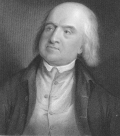
I often hear (or see) it said that, according to Jeremy Bentham (1748-1832), natural rights are "nonsense on stilts." That's not what he said. In Anarchical Fallacies (c. 1791), Bentham, discussing the French Declaration of the Rights of Man and of the Citizen (1789), heaped scorn on Article II, which, in the version Bentham quotes, reads as follows:
The end in view of every political association is the preservation of the natural and imprescriptible rights of man. These rights are liberty, property, security, and resistance to oppression.
Bentham wrote:
That which has no existence cannot be destroyed—that which cannot be destroyed cannot require anything to preserve it from destruction. Natural rights is simple nonsense: natural and imprescriptible rights, rhetorical nonsense—nonsense upon stilts. (Italics in original.)
Bentham has no problem with rights or rights-talk. As a legal positivist, he recognizes that rights can be and are created by human beings. What's nonsense is natural rights, for these, by definition, preexist government and can be wielded against government. What's nonsense upon stilts is imprescriptible natural rights. What are imprescriptible rights? According to Black's Law Dictionary, 5th ed. (1979), they are "Such rights as a person may use or not, at pleasure, since they cannot be lost to him by the claims of another founded on prescription." "Prescription" is defined as "Acquisition of a personal right to use a way, water, light and air by reason of continuous usage."
Here is an example of the sloppiness of which I speak. In his 1982 essay "Moral Reality" (Wisconsin Law Review, 1061-156), law professor Michael Moore writes: "Property theorists who are moral skeptics tend to avoid the natural rights theory. These skeptics agree with Bentham's assertion that 'natural rights are simply nonsense . . . nonsense on stilts'" (p. 1069; ellipsis in original). Moore's excision makes it sound as though Bentham were characterizing natural rights per se as "nonsense on stilts." He was not. If scholars such as Moore can't get little things right, how can they be trusted to get big things right?
To summarize Bentham's view:
- Rights: not nonsense.
- Natural rights: nonsense.
- Imprescriptible natural rights: nonsense on stilts.
As you were.
 Keith Burgess-Jackson, J.D., Ph.D.