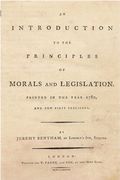
 So much with regard to acts considered in themselves: we come now to speak of the circumstances with which they may have been accompanied. These must necessarily be taken into the account before any thing can be determined relative to the consequences. What the consequences of an act may be upon the whole can never otherwise be ascertained: it can never be known whether it is beneficial, or indifferent, or mischievous. In some circumstances even to kill a man may be a beneficial act: in others, to set food before him may be a pernicious one.
(Jeremy Bentham, An Introduction to the Principles of Morals and Legislation, ed. J. H. Burns and H. L. A. Hart, in The Collected Works of Jeremy Bentham, ed. F. Rosen and Philip Schofield [Oxford: Clarendon Press, 1996], chap. 7, sec. 21, p. 79 [italics in original] [book first published in 1789])
Note from KBJ: To a consequentialist such as Bentham, only consequences matter, morally. That an act is of a certain type, such as lying, torturing, or killing an innocent human being, is irrelevant. An act of each type can be right or wrong, depending on whether its consequences are best. Deontologists reject this approach. They hold that certain types of act are intrinsically wrong, i.e., wrong independently of their consequences. You can see why consequentialism has been the theory of choice for tyrants. The end justifies the means. In other words, no means are ruled out. If genocide is necessary to bring about socialist utopia, then genocide is right.
 Keith Burgess-Jackson, J.D., Ph.D.