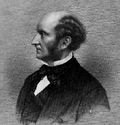
 The work of the years 1860 and 1861 consisted chiefly of two treatises, only one of which was intended for immediate publication. This was the “Considerations on Representative Government”; a connected exposition of what, by the thoughts of many years, I had come to regard as the best form of a popular constitution. Along with as much of the general theory of government as is necessary to support this particular portion of its practice, the volume contains my matured views of the principal questions which occupy the present age, within the province of purely organic institutions, and raises, by anticipation, some other questions to which growing necessities will sooner or later compel the attention both of theoretical and of practical politicians. The chief of these last, is the distinction between the function of making laws, for which a numerous popular assembly is radically unfit, and that of getting good laws made, which is its proper duty and cannot be satisfactorily fulfilled by any other authority: and the consequent need of a Legislative Commission, as a permanent part of the constitution of a free country; consisting of a small number of highly trained political minds, on whom, when Parliament has determined that a law shall be made, the task of making it should be devolved: Parliament retaining the power of passing or rejecting the bill when drawn up, but not of altering it otherwise than by sending proposed amendments to be dealt with by the Commission. The question here raised respecting the most important of all public functions, that of legislation, is a particular case of the great problem of modern political organization, stated, I believe, for the first time in its full extent by Bentham, though in my opinion not always satisfactorily resolved by him; the combination of complete popular control over public affairs, with the greatest attainable perfection of skilled agency.
Note from KBJ: Mill would love the modern bureaucratic state.
 Keith Burgess-Jackson, J.D., Ph.D.