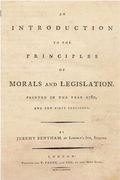
 The consequences we have hitherto been speaking of, are the natural consequences, of which the act, and the other articles we have been considering, are the causes: consequences that result from the behaviour of the individual, who is the offending agent, without the interference of political authority. We now come to speak of punishment: which, in the sense in which it is here considered, is an artificial consequence, annexed by political authority to an offensive act, in one instance; in the view of putting a stop to the production of events similar to the obnoxious part of its natural consequences, in other instances.
(Jeremy Bentham, An Introduction to the Principles of Morals and Legislation, ed. J. H. Burns and H. L. A. Hart, in The Collected Works of Jeremy Bentham, ed. F. Rosen and Philip Schofield [Oxford: Clarendon Press, 1996], chap. 12, sec. 36, pp. 156-7 [italics in original] [book first published in 1789])
Note from KBJ: Bentham's utilitarian aim is to make it rational for individuals to engage in utility-maximizing behavior. Suppose I am tempted to commit a certain crime. The state threatens me with punishment if I proceed. When I take this artificial cost of my conduct into account, it will turn out that it is not in my interest (after all) to commit the crime. The job of a legislator is to set the punishment in the right place. It should be just sufficient to deter.
 Keith Burgess-Jackson, J.D., Ph.D.