Here.
-
Dilbert
–––––––
-
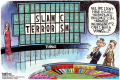 Some people profess to be puzzled by Barack Obama's reluctance to use the terms "Islamic terrorism," "radical Islamic terrorism," and "Islamism." I think it's pretty simple. Obama sincerely believes that Islam is a great and peaceful religion. This doesn't mean that every adherent of Islam is peaceful. It means that the religion itself, viewed as a religion, is peaceful. Obama is afraid that if he links terrorism to Islam, uneducated people will think it's the religion itself rather than a small subset of its fanatical adherents that's at fault. Why risk this? Why take a chance that even one person will think Islam per se is at fault for the terrorist attacks being made around the world?
It's really that simple. But notice the implication. Not everyone is as smart as Obama. He knows that the religion is peaceful, but many Americans do not. By speaking carefully (some would say "dishonestly"), he avoids linking the religion (Islam) to the terrorism in people's minds. So it comes down to condescension. Obama alters the way he speaks in order to keep the yahoos from drawing an erroneous conclusion.
A respectful leader would speak openly and clearly to the people, and not assume that they are too stupid to keep the religion and its fanatics separate. Leftists are fond of playing around with language to achieve their ends. This is but one example of it. It's called "manipulative rhetoric," or rhetoric in the service of a cause. George Lakoff has been at the forefront of efforts to help leftists frame issues by using carefully chosen emotive language.
Donald Trump appeals to many of us because he doesn't play these linguistic games. He trusts people to know the difference between Islam (the religion) and Muslims who act in the name of their religion. An honest discussion of the problem of terrorism would include reading those parts of the Koran that deal with how Muslims should treat nonMuslims. Is terrorism indigenous to Islam, in other words, or foreign to it? Almost nobody in the mainstream media wants to touch this issue, so all we get are platitudes from the likes of Obama to the effect that Islam is peaceful and would never sanction or support terrorism.
Language
–––––––
-
To the Editor:
Re “Senate Votes for Women to Register for the Draft” (news article, June 15):
As a veteran of the Navy Nurse Corps, I wholeheartedly support requiring women to register for the draft. We women have long demanded equality. There is no reason that we should then leave it to men to serve and protect our country.
The argument that we are requiring young women to go into combat is nonsense. Although combat roles are now open to women, even many men who serve in the military in times of war never see combat.
The military is a very large organization employing everyone from supply personnel and drivers to cooks, chaplains and office workers. It is about time that we asked the same patriotic duty of women that we ask of men.
ANNE-MARIE HISLOP
Chicago
Note from KBJ: It's far too late in the day for women to be exempt from military service. They've been arguing for decades that they can do everything men can do, if not more. Let's put that claim to the test.
From Today’s New York Times
–––––––
-
Everybody Knows This Is Nowhere (1969). This is for my wife, Katherine, who brought me cinnamon rolls from Waco the other day.
-
Here.
Ten Years Ago Today in This Blog
–––––––
-
Here.
Dilbert
–––––––
-
Anybody care to answer this man's question?
Ethics
–––––––
-
That’s the Way I Feel Now: A Tribute to Thelonious Monk (1984). Incredible.
-
To the Editor:
Re “Washington Post Barred From Trump’s Campaign” (Business Day, June 14):
This story sent chills down my spine.
Donald Trump’s effort to squelch journalism—whatever its form—is probably the most ominous predictor of what he’ll be capable of doing if he becomes president.
Don’t like what they’re saying about you? Off with their heads!
I would have liked to see this story on the front page above the fold.
ANNE BERNAYS
Cambridge, Mass.
The writer teaches at Harvard’s Nieman Foundation for Journalism.
Note from KBJ: This is dishonest. Donald Trump can't stop reporters from covering his campaign. What he can do, and has every right to do, is refuse to talk to any reporter who treats him unfairly.
Note 2 from KBJ: Someone should inform the letter writer—a professor of journalism!—that a paragraph may contain more than one sentence.
From Today’s New York Times
–––––––
-
This essay (which purports to be a transcription of a commencement address given at Cal Tech by Atul Gawande) is laughably naive and tendentious. Let me take it apart by quoting a few paragraphs and inserting my comments (in brackets and boldface) after some of them:
People are prone to resist scientific claims when they clash with intuitive beliefs. They don’t see measles or mumps around anymore. They do see children with autism. And they see a mom who says, “My child was perfectly fine until he got a vaccine and became autistic.” [Is people's reasoning really this simplistic? The author is committing a straw-person fallacy.]
Now, you can tell them that correlation is not causation. You can say that children get a vaccine every two to three months for the first couple years of their life, so the onset of any illness is bound to follow vaccination for many kids. You can say that the science shows no connection. But once an idea has got embedded and become widespread, it becomes very difficult to dig it out of people’s brains—especially when they do not trust scientific authorities. And we are experiencing a significant decline in trust in scientific authorities. [According to Keith's Law, authoritativeness is inversely proportional to partisanship. As scientists have become more partisan, their authoritativeness has decreased. The author seems unaware of Keith's Law.]
The sociologist Gordon Gauchat studied U.S. survey data from 1974 to 2010 and found some deeply alarming trends. Despite increasing education levels, the public’s trust in the scientific community has been decreasing. This is particularly true among conservatives, even educated conservatives. In 1974, conservatives with college degrees had the highest level of trust in science and the scientific community. Today, they have the lowest. [This is an instance of what James Taranto calls "the Butterfield Fallacy." Journalist Fox Butterfield noticed that the incarceration rate was increasing at the same time that the crime rate was decreasing. This puzzled him; he expected the incarceration rate to decrease as the crime rate decreased. What he failed to see is that the crime rate decreased because the incarceration rate increased. Gawande notices that mistrust of science is increasing at the same time that education levels are increasing. This puzzles him; he expects mistrust of science to decrease as education levels increase. What he fails to see is that mistrust of science is increasing because education levels are increasing. I will return to this point later in the post.]
Today, we have multiple factions putting themselves forward as what Gauchat describes as their own cultural domains, “generating their own knowledge base that is often in conflict with the cultural authority of the scientific community.” Some are religious groups (challenging evolution, for instance). Some are industry groups (as with climate skepticism). Others tilt more to the left (such as those that reject the medical establishment). As varied as these groups are, they are all alike in one way. They all harbor sacred beliefs that they do not consider open to question. [The author's lack of self-awareness is hilarious. The people who harbor the most sacred beliefs these days—beliefs that are not considered "open to question"—are climate scientists. Climate science has all the trappings of religion. It has priests, heretics, and blasphemers; it excommunicates; it sells indulgences; and, in good dogmatic fashion, it takes its views on faith.]
To defend those beliefs, few dismiss the authority of science. They dismiss the authority of the scientific community. People don’t argue back by claiming divine authority anymore. They argue back by claiming to have the truer scientific authority. It can make matters incredibly confusing. You have to be able to recognize the difference between claims of science and those of pseudoscience. [The author seems dimly aware of a distinction between science and its practitioners, but he usually conflates the two. What people such as me object to is not science per se, but scientists, especially those who are politicized. (The politicization is invariably in the direction of progressivism.) By the way, the question of what counts as science is neither a scientific question nor a medical question; it is a philosophical question. The author has no scientific or philosophical credentials. He is a medical doctor. (Medical doctors are not scientists; they are practitioners of a craft that purports to be grounded in science.)]
Science’s defenders have identified five hallmark moves of pseudoscientists. They argue that the scientific consensus emerges from a conspiracy to suppress dissenting views. They produce fake experts, who have views contrary to established knowledge but do not actually have a credible scientific track record. They cherry-pick the data and papers that challenge the dominant view as a means of discrediting an entire field. They deploy false analogies and other logical fallacies. And they set impossible expectations of research: when scientists produce one level of certainty, the pseudoscientists insist they achieve another. [I could easily come up with "five hallmark moves of scientists," where by "scientists" I mean practitioners of scientism.]
It’s not that some of these approaches never provide valid arguments. Sometimes an analogy is useful, or higher levels of certainty are required. But when you see several or all of these tactics deployed, you know that you’re not dealing with a scientific claim anymore. Pseudoscience is the form of science without the substance. [This claim is being uttered by someone with neither scientific nor philosophical credentials, so take it with a grain of salt.]
The challenge of what to do about this—how to defend science as a more valid approach to explaining the world—has actually been addressed by science itself. Scientists have done experiments. In 2011, two Australian researchers compiled many of the findings in “The Debunking Handbook.” The results are sobering. The evidence is that rebutting bad science doesn’t work; in fact, it commonly backfires. Describing facts that contradict an unscientific belief actually spreads familiarity with the belief and strengthens the conviction of believers. That’s just the way the brain operates; misinformation sticks, in part because it gets incorporated into a person’s mental model of how the world works. Stripping out the misinformation therefore fails, because it threatens to leave a painful gap in that mental model—or no model at all. [Let me get this straight: Science has addressed the question of how to defend science as a "more valid approach to explaining the world." How convenient!]
So, then, what is a science believer to do? Is the future just an unending battle of warring claims? Not necessarily. Emerging from the findings was also evidence that suggested how you might build trust in science. Rebutting bad science may not be effective, but asserting the true facts of good science is. And including the narrative that explains them is even better. You don’t focus on what’s wrong with the vaccine myths, for instance. Instead, you point out: giving children vaccines has proved far safer than not. How do we know? Because of a massive body of evidence, including the fact that we’ve tried the alternate experiment before. Between 1989 and 1991, vaccination among poor urban children in the U.S. dropped. And the result was fifty-five thousand cases of measles and a hundred and twenty-three deaths. [A nit-picky point: The author uses the expression "true facts." Is there such a thing as a nontrue fact?]
The other important thing is to expose the bad science tactics that are being used to mislead people. Bad science has a pattern, and helping people recognize the pattern arms them to come to more scientific beliefs themselves. Having a scientific understanding of the world is fundamentally about how you judge which information to trust. It doesn’t mean poring through the evidence on every question yourself. You can’t. Knowledge has become too vast and complex for any one person, scientist or otherwise, to convincingly master more than corners of it. [So we're all in the same boat.]
Few working scientists can give a ground-up explanation of the phenomenon they study; they rely on information and techniques borrowed from other scientists. Knowledge and the virtues of the scientific orientation live far more in the community than the individual. When we talk of a “scientific community,” we are pointing to something critical: that advanced science is a social enterprise, characterized by an intricate division of cognitive labor. Individual scientists, no less than the quacks, can be famously bull-headed, overly enamored of pet theories, dismissive of new evidence, and heedless of their fallibility. (Hence Max Planck’s observation that science advances one funeral at a time.) But as a community endeavor, it is beautifully self-correcting. [The author is quite right that "advanced science is a social enterprise." This is why scientists, being human and social, fall prey to such things as solidarity (sticking together, especially when threatened from outside), defensiveness (this commencement address is a case in point), and peer pressure. It's always an open question, when scientists agree on something, whether the agreement is rooted in fact (i.e., how things are) or in politics (i.e., how scientists would like things to be). The reason there are so many climate-change skeptics is that those defending climate change are overwhelmingly progressive in their politics. The author doesn't so much as mention this fact. In fact, shouldn't science be investigating this matter? Isn't there a potential conflict of interest?]
Beautifully organized, however, it is not. Seen up close, the scientific community—with its muddled peer-review process, badly written journal articles, subtly contemptuous letters to the editor, overtly contemptuous subreddit threads, and pompous pronouncements of the academy— looks like a rickety vehicle for getting to truth. Yet the hive mind swarms ever forward. It now advances knowledge in almost every realm of existence—even the humanities, where neuroscience and computerization are shaping understanding of everything from free will to how art and literature have evolved over time.
Today, you become part of the scientific community, arguably the most powerful collective enterprise in human history. In doing so, you also inherit a role in explaining it and helping it reclaim territory of trust at a time when that territory has been shrinking. In my clinic and my work in public health, I regularly encounter people who are deeply skeptical of even the most basic knowledge established by what journalists label “mainstream” science (as if the other thing is anything like science)—whether it’s facts about physiology, nutrition, disease, medicines, you name it. The doubting is usually among my most, not least, educated patients. Education may expose people to science, but it has a countervailing effect as well, leading people to be more individualistic and ideological. [In other words, the more educated you are, the less herdlike you are. This is a good thing, not a bad thing, though would-be shepherds such as the author would beg to disagree.]
The mistake, then, is to believe that the educational credentials you get today give you any special authority on truth. What you have gained is far more important: an understanding of what real truth-seeking looks like. It is the effort not of a single person but of a group of people—the bigger the better—pursuing ideas with curiosity, inquisitiveness, openness, and discipline. As scientists, in other words. [I said I'd come back to this. The more educated people become, the more they are able to spot (1) self-serving behavior, (2) bias, (3) fallacious reasoning, and (4) the role played by personal, moral, and political factors in what are supposed to be value-neutral activities. Scientists loved it when the education level was low(er), for it was much easier for them to hoodwink people. The people are now on to them, and they hate it. Like the Wizard of Oz, they've been exposed for what they are: partisan political hacks masquerading as veracious inquirers. Incidentally, society as a whole is "bigger" than the community of scientists, so, by the author's own logic, society is "better" at getting the truth about things than is the scientific community alone.]
Enjoy!
Science
–––––––

