Here.
-
Ten Years Ago Today in This Blog
–––––––
-
Here.
Dilbert
–––––––
-
To the Editor:
Re “Academia’s Rejection of Diversity” (Op-Ed, Oct. 31):
Arthur C. Brooks is asking the wrong question. The question is not whether we need more conservative viewpoints in academia but why there are so few conservatives in academia. Not all ideas are of equal validity and thus deserving of equal time in college classrooms. Some ideas are empirically better than others.
The liberal version of reality predominates in academia because, quite simply, it is closer to the truth.
For example, the conservative view of biology and geology (that humans are a product of divine creation and the world is 6,000 years old) is just flat-out wrong.
And the conservative view of economics (that cutting taxes and expenditures during a recession results in greater prosperity) has been proven time and again to be false.
Another reason for the prevalence of liberal thought on college campuses was given long ago by a social scientist: It is just more humane. Liberals seek to treat all races, religions, classes, genders and so on equally compared with conservatives, who want a pre-1960 America.
And whereas all humans are created equal, the same cannot be said for all ideas.
BRUCE SHEIMAN
New York
Note from KBJ: Bruce Sheiman isn't smart enough to realize that his letter makes the conservative point. He has a cartoon version of conservatism. How did that come about? Undoubtedly, because he hasn't been exposed at school to a real live conservative!
From Today’s New York Times
–––––––
-
The Great Climate Hoax
–––––––
-
 Congratulations to the Kansas City Royals, their fans, and their management. The Royals won the World Series in five games, over the New York Mets. (I have no idea how the Mets got this far. They showed me nothing.) The Royals won the World Series in 1985, when I lived in Tucson. I remember it well, because I was rooting for the Royals, who had had much bad luck until then. I'm not the least bit surprised that this year's team won it all. Losing the 2014 World Series in seven games to the San Francisco Giants, with the deciding game being decided by one run, was heartbreaking for the players and their fans. I knew they'd be back to win it all, and they did. I've never seen a scrappier team. Almost on a daily basis this season, the team came from behind to win. Next up: the annual awards. Look for Adrian Beltre of the Texas Rangers to be named the Most Valuable Player of the American League. With him, they won the division. Without him, they finish in third place.
Baseball
–––––––
-
Here.
Ten Years Ago Today in This Blog
–––––––
-
Here.
Dilbert
–––––––
-
To the Editor:
Re “Meat as a Cause of Cancer” (editorial, Oct. 28): The lifetime risk of colorectal cancer is about 5 percent. Those who eat a large amount of processed meats may increase their risk by up to 20 percent, which might increase the risk to about 6 percent. In other words, 94 to 95 percent of us will not get colon cancer even if we eat a lot of that not so healthy good stuff like bacon and hot dogs.
Personally, I’d rather get a colonoscopy (and I have) every 10 to 12 years (I’m 79 and can stop now), and have a B.L.T. or grilled frank every week or two.
LONNIE HANAUER
West Orange, N.J.
The writer is a rheumatologist.
To the Editor:
Re “Report Links Risk of Some Cancers to the Consumption of Processed or Red Meat” (news article, Oct. 27):
Meat, especially processed meat, may well cause cancer, though the risk seems to remain low based on the available evidence.
However, based on years of strong evidence, the raising of cows and pigs has a significant enough effect on climate disruption that we should all stop eating red meat, processed or not.
Dr. John Ioannidis of Stanford suggested that it is important not to “terrorize people into thinking that they should not eat any red meat at all.”
I disagree. The threat of climate disruption should terrorize people into doing whatever it takes to mitigate the threat. That includes not eating meat.
SARA R. NICHOLS
Los Angeles
From Today’s New York Times
–––––––
-
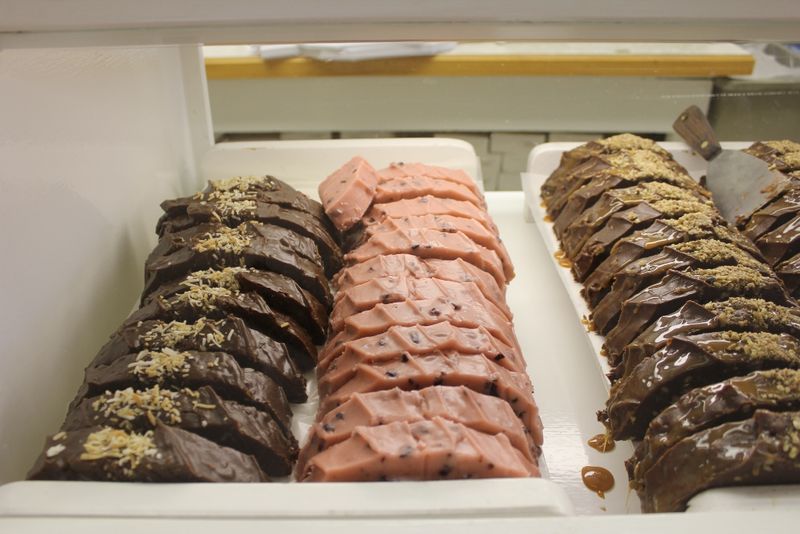
Mackinac Island fudge. Click to enlarge.
Michigan #20
–––––––
-
This blog had 5,119 visits during October, which is an average of 165.1 visits per day. A year ago, the average was 198.7.
Statistics
–––––––

