Here.
-
Dilbert
–––––––
-
 Utilitarianism claims to be a rational moral theory in at least three ways. First, it claims to give us an objective standard of morality, a way of deciding moral issues, not in the light of what each of us happens to like or dislike, but on publicly verifiable grounds. Secondly, by offering only one criterion of morality it assures consistency. If we accept a system which invokes two or more independent principles, there is always the possibility of insoluble conflict. For example, if we take our stand on the Ten Commandments, we cannot, without divine revelation, be sure that we shall not one day find ourselves in a situation in which we must break one or other of them; and our system gives us no guide as to which we ought to break. By claiming that all such conflicts can, in principle, be resolved utilitarianism satisfies the demand of our rationality that no moral problem should be insoluble.
Thirdly, by incorporating the principle that, in making our calculations of utility, each person is to count for one and no person for more than one, utilitarianism appeals to our sense of justice, and justice is the most rational of the moral virtues. For injustice in action is, as Hobbes said, like absurdity in speech, using the word 'absurd' in the sense in which it is to be found in school geometry books. To be unjust is to treat two people differently when there is no relevant difference between them, without, that is to say, any reason for differential treatment.
But alas!, our demands are not always met, and the demands of our rationality are no exception. As rational beings, we all have a powerful motive, and as philosophers we have a specially powerful motive for believing that some form of utilitarianism will turn out to be correct; so it is not surprising that more and more elaborate versions of the theory have been proposed in recent years, to be answered by more and more sophisticated refutations. As one studies the moves and counter-moves the suspicion begins to grow that no formulation acceptable to all rational men can ever be produced and that this situation may be due to some fundamental misconception of the nature of morality.
(P. H. Nowell-Smith, "Some Reflections on Utilitarianism," Canadian Journal of Philosophy 2 [June 1973]: 417-31, at 417-8 [italics in original])
-
The Dark Side of the Moon (1973).
-
Here is Ann Coulter's latest column. Ann is excitable. She should calm down. President Trump is a master negotiator, and he knows full well that building a wall is not negotiable. The wall will get built.
-
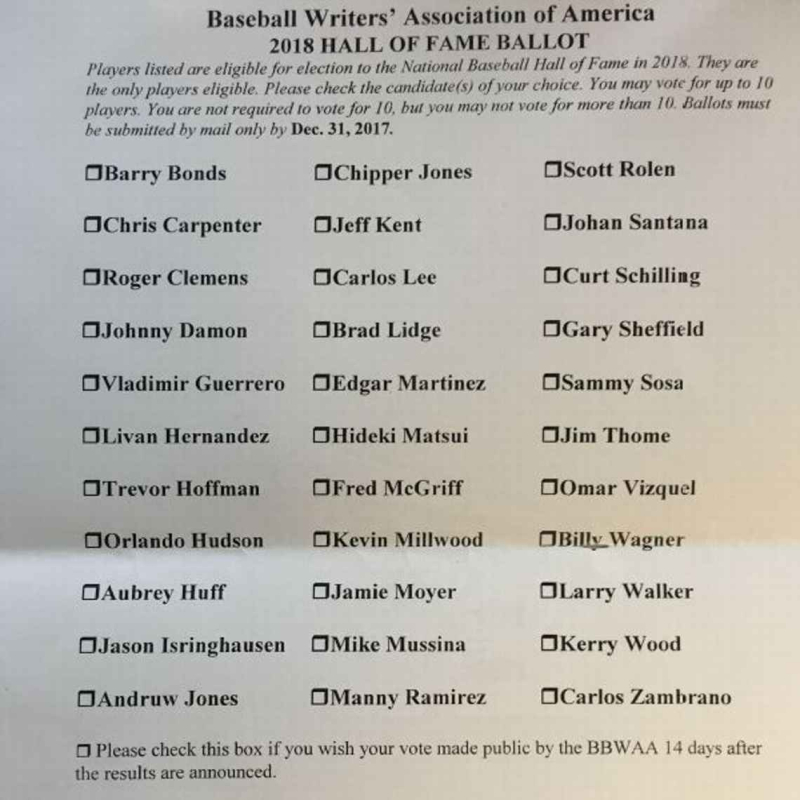
Here are my picks: Trevor Hoffman, Chipper Jones, Manny Ramirez, and Curt Schilling.
Baseball
–––––––
-
President Donald Trump is asking Congress for a 10-year allocation of $18 billion for his big beautiful border wall with Mexico ("$18 billion sought to begin wall on border," Jan. 5), with the first $1.6 billion to replace 74 miles of fence in the current year 2018. My eyes glaze over when numbers get into the billions. So I did the math.
That's more than $21 million per mile, or $4,095 per foot of fence. Now we're starting to talk real money. Since this budget request is to replace fencing, presumably the U.S. already owns the land or easements, so that price doesn't even include the land.
During Trump's 2017 campaign, he bragged about how he is a builder and therefore he knows how to build a really good wall. At that price, it had better be good. He also told us ad nauseum [sic] that Mexico would pay for it. U.S. voters fell for this charlatan, but Mexico didn't, and now Trump's true intent is becoming clear.
There's no money for children's health, but Trump is opening public lands and offshore waters to oil drilling with no recognition of global climate change or providing any resources to slow it down. He provided inadequate help for hurricane-slammed Puerto Rico. Social security and Medicare will soon be under the axe, but Trump's priority is to build that border wall, costs be damned.
Martha Peck Andrews, Northeast Portland
-
The single greatest Witch Hunt in American history continues. There was no collusion, everybody including the Dems knows there was no collusion, & yet on and on it goes. Russia & the world is laughing at the stupidity they are witnessing. Republicans should finally take control!
— Donald J. Trump (@realDonaldTrump) January 10, 2018
Presidential Tweet
–––––––
-
Male-female relations are in a state of flux. It'll be interesting to see how things shake out. It seems to me that there are three prohibitions:
- Don't force anyone to do anything. (I mean physical force.) This includes not touching people without their consent.
- Don't coerce anyone to do anything. This means not threatening harm, where "harm" means any setback to interest. Don't threaten to fire someone for not having sex with you. Don't intimidate, harass, or badger.
- Don't manipulate anyone. One chief means of manipulation is deception. Be honest and forthright in your communications with others. If someone shows no interest in your romantic overture, back off and stay away.
You're welcome.
Sexual Misconduct
–––––––
-
Propositional form X is consistent with propositional form Y (i.e., X and Y are consistent [with one another]) iff it is possible for both X and Y to be true.
Example from everyday life: 'x is not taller than y' is consistent with 'y is not taller than x'
Example from categorical logic: 'Some S are P' is consistent with 'Some S are not P'
Example from propositional logic: 'p' is consistent with 'p ≡ q'
Example from predicate logic: '(x)Øx' is consistent with '(Ǝx)Øx'
Consistency
–––––––
-
Here.
Ten Years Ago Today in This Blog
–––––––

