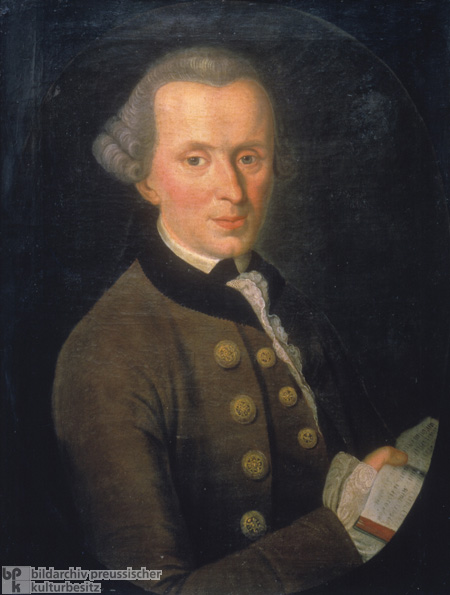
When Heilsberg says that Kant was "no great devotee (Verehrer) of the female sex," he did not mean that Kant looked down on women or that he was a misogynist, but rather that he was not someone for whom sexual exploits were important as a means of proving himself. "He felt marriage to be a desire and to be a necessity," but he never took the final step. Once there was "a well brought up and beautiful widow from somewhere else, who visited relatives." Kant did not deny that she was a woman with whom he would have loved to share his life; but "he calculated income and expenses and delayed the decision from one day to the next." The beautiful widow visited other relatives, and she married there. Another time he "was touched by a young Westphalian girl," who had accompanied a noble woman to Königsberg. He was "pleased to be with her in society, and he let this be known often," but again he waited too long. He was still thinking of making an offer of marriage when she reached the Westphalian border.
After that, he never thought of marriage again. Neither did he appreciate suggestions from friends in that regard, preferring not to go to a party if there were likely to be exhortations in this direction. During his early years, marriage would indeed have been difficult for financial reasons. He himself is said to have quipped that when he could have benefited from being married, he could not afford it, and when he could afford it, he could no longer have benefited from it. He was not alone in this. Many a scholar in eighteenth-century Germany had to endure the same fate and live the life of a celibate simply because he could not support a wife and children. Some found rich widows, who could support them, but they were exceptions.
Whether Kant ever really understood women is an open question. That he understood them less and less as he grew older is very likely. That his view of the social and political role of women was largely traditional is without a doubt also true, but it is not entirely so. Kant was influenced by more progressive views, and he in turn influenced such views. Given that in Kant's time there were no female students, and that he encountered women only in clearly circumscribed and mostly very formal social contexts, not much more could be expected.
(Manfred Kuehn, Kant: A Biography [Cambridge: Cambridge University Press, 2001], 117-8 [endnotes omitted])
Note from KBJ: Kant had the misfortune to be born before the automobile was invented.