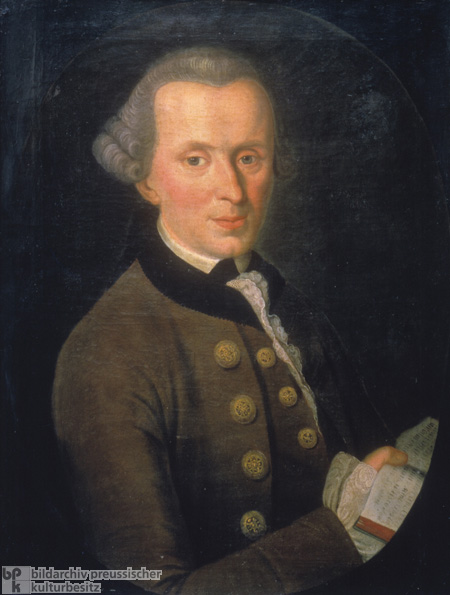
[F]or more than thirty years Kant ate lunch at a pub, and during that time he mixed with a great variety of different people. Kant thus did not always live the withdrawn life that many people associate with a philosopher of his standing. Far from it: when he was not invited to a dinner party, he ate in the company of men with very different backgrounds from his own, and he enjoyed it.
The choice of entrees was also important to Kant. Nothing too fancy, the meat well-done, good bread, and good wine. During his early years he preferred red wine, late in life he liked white wine better. He loved to eat at a leisurely pace, and, if he liked a particular dish, he inquired about the recipe and how it was prepared. But he was also free with his criticism. Hippel later joked that "sooner or later he would be writing a Critique of the Art of Cooking."
His daily schedule then looked something like this. He got up at 5:00 A.M. His servant Martin Lampe, who worked for him from at least 1762 until 1802, would wake him. The old soldier was under orders to be persistent, so that Kant would not sleep longer. Kant was proud that he never got up even half an hour late, even though he found it hard to get up early. It appears that during his earlier years, he did sleep in at times. After getting up, Kant would drink one or two cups of tea—weak tea. With that, he smoked a pipe of tobacco. The time he needed for smoking it "was devoted to meditation." Apparently, Kant had formulated the maxim for himself that he would smoke only one pipe, but it is reported that the bowls of his pipes increased considerably in size as the years went on. He then prepared his lectures and worked on his books until 7:00. His lectures began at 7:00, and they would last until 11:00. With the lectures finished, he worked again on his writings until lunch. Go out to lunch, take a walk, and spend the rest of the afternoon with his friend Green. After going home, he would do some more light work and read.
This was the "peaceful situation that is exactly fitted to my needs: in turn occupied with work, speculation, and society." It was a regular or even regulated way of life, but it was hardly mechanical. Lecturing, writing, and reading were interrupted by conversation, relaxation, and even play. No doubt, Green's influence had had its effect. Kant's "character" had begun to form. It was characterized by his "constant striving to act in accordance with thought-out maxims, which—at least in his opinion—were well founded principles, and by his eagerness to formulate maxims in all the greater and smaller, more and less important matters, from which he always began and to which he always returned." His "maximized" life was not—at least not at this point—disadvantageous to his work or life. Indeed, his life according to maxims seems to have made both his work and his life more pleasant. They contributed to the smooth and regular flow of his life that he valued over everything.
(Manfred Kuehn, Kant: A Biography [Cambridge: Cambridge University Press, 2001], 221-2 [italics in original; endnotes omitted])
Note from KBJ: By comparison with my life, Kant's life was chaotic.