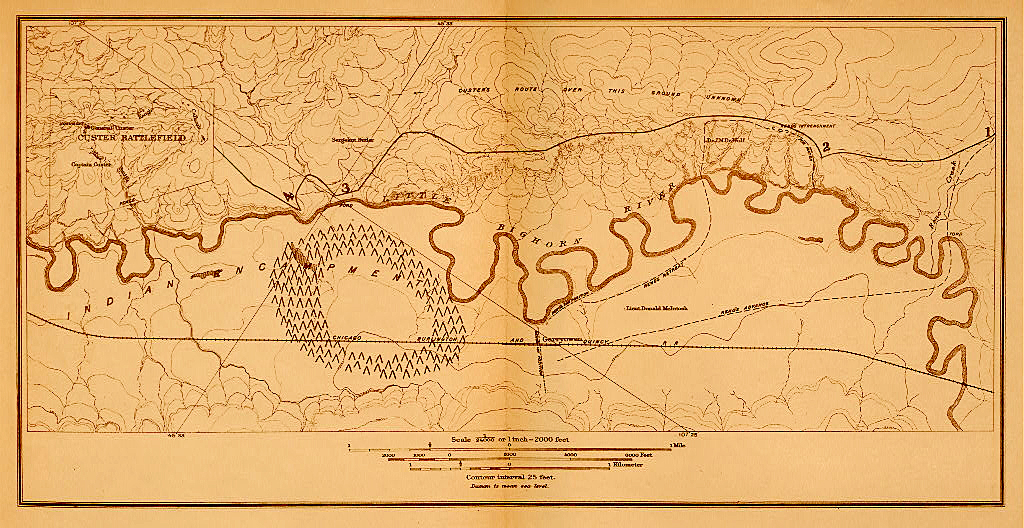
6-8-89 Thursday. Everyone has a magical day now and then, a day that he or she has long imagined and will never forget. For me, today was such a day, for reasons to be spelled out shortly. We broke camp early, at 7:50 A.M., stopping in Sheridan, Wyoming, for breakfast at a Perkins Family Restaurant (the culinary equivalent of Denny’s). By eleven o’clock, under clear, blue skies and in warm weather, we were in Lodge Grass, Montana, twenty road miles south of the Custer Battlefield. The plan was for David and me to kayak to Crow Agency, just north of the battlefield, where Ellen would meet us in the van. Neither of us knew whether such kayaking was permitted, but we had determined to do it anyway. If the Crow Indians didn’t like it (we were on their reservation), they could order us off the water. Until then, we were waterborne. As for the river, we had followed it for several miles as we drove northward in the van. It appeared not only wide enough for us, but quite rapid in some places. Brash youths that we are, we predicted that we’d cover the twenty miles in four hours. Heck, if we just floated, without paddling, we’d make it in five or six hours. David and I were in good spirits as we pushed off from the muddy shore. Ellen waved to us from the bridge as we moved with the current.
Not five minutes after embarking, I capsized the kayak. I still don’t know what caused it, though I suspect that it was the distribution of weight in and on the kayak. Heretofore, I’ve paddled an empty kayak, but today I had a couple of bags aboard, one of them strapped to the top. That destabilized the kayak, and since I’m jittery anyway when getting started, I lost control and rolled into the water. Luckily, it was shallow; I simply stood up, grabbed the cord on the front of the kayak, and walked ashore with it. My [Pentax K1000] camera was soaked and did not work for the rest of the day. Damn! While David stayed in the water, I emptied the kayak and got back in. Wouldn’t you know it? Here I am, on the river trip of my dreams, and I get soaked in the first five minutes and lose the chance to take pictures of the Little Bighorn River. I asked David whether Ellen saw me fall in. He said “No”, that she had just walked away from the bridge when I capsized. That’s good; otherwise, she would have worried about us all day. As it turns out, Ellen had reason to worry. David and I grossly underestimated the extent to which the Little Bighorn meanders. Back and forth we went, turning to the right, then to the left, then to the right again. At first, we didn’t notice; it was just fun to be in the water after several days of traveling in the van. But as the hours ticked away, we grew concerned that we weren’t making the progress we expected. By 5:30, when we were supposed to meet Ellen in Crow Agency, we hadn’t reached Reno Creek, let alone the Custer Battlefield. We knew that Reno Creek empties into the Little Bighorn four land miles from the battlefield.
At seven o’clock, having been in the water almost continuously for eight hours (we pushed off at 11:12 A.M.), we decided to pull the kayaks ashore and walk to the highway. We knew it was nearby because we could hear the sound of passing vehicles from time to time. The main concern, besides lacking food, water, and camping gear for the night, was Ellen. We had no way to contact her and knew that she would be worried sick about us. We were already ninety minutes late. My pants were still wet from the earlier dunking, and David fell backward into a muddy area as we climbed out of the river bottom, so we must have been a sight for passing motorists near the highway. The plan, at this point, was to wait for Ellen to come by, as we knew she must. Thirty minutes after reaching the highway, however, a police officer drove by on the frontage road. David went down to talk to him. His first words were “Are you the kayakers?”. This told us that Ellen had contacted the authorities. David gave the officer the details of our plight and came back to wait for me. Forty-five minutes later, during which time it got dark and we began shivering, Ellen drove up in the van. We walked back to get the kayaks, lashed them to the top of the van, and crawled in, exhausted by the eight hours of paddling in the warm sunshine. Ellen had already selected a campground for the evening, in nearby Hardin, so she drove us there straightway. With no further ado, I pitched the tent, showered, and ate dinner.
As we stood on the shoulder of the highway waiting for Ellen, David and I estimated the number of miles we had paddled. David’s estimate was thirty-six; mine was twenty-three. I based mine on the number of hours we paddled and the rate at which we moved through the water. From time to time I looked ashore, imagining that I were walking at my usual, brisk four-mile-per-hour pace. I think we were traveling at about three miles per hour for just over seven hours. (We spent about an hour either ashore or portaging the kayaks.) Perhaps my estimate is low and David’s high. If so, then we may have gone as far as thirty miles today. Unfortunately, we were still a good ten road miles from the battlefield. In fact, I could see a stand of trees on a ridge in the distance. I knew that large evergreen trees had been planted on Custer Hill near the visitor center, and those that I saw were in the right direction. (I later learned that I was right about this.) How could we have underestimated the river mileage so egregiously? Naturally, I was discouraged by our failure to paddle past the battlefield. We considered putting the kayaks in the water again in the morning to complete the trip, but decided against it. Better to move on, we thought. Both of us were dog-tired and neither was anxious to get back in the water for a few days.
Today’s experience gives David and me pause. David is concerned about his stamina, while I’m concerned about the dirt, cold, and wetness of a kayak trip. For example, what if I had capsized in the Mackenzie River, where the water temperature is much lower? Could I have climbed back into the kayak and continued, or would we have had to camp for the evening so that I could change my clothes and dry my wet gear? As I explained to David, I’m not so much concerned with my ability to paddle for three to four weeks as I am with my ability to cope with the mundane aspects of the trip. It’s one thing to work hard all day in the kayak, sometimes under trying and uncomfortable conditions; it’s another to have to set up camp, prepare food, and stay clean and healthy while we’re doing it. In the Tour de France bicycle race, for example, the riders know that at the end of each day they will have (1) a hot shower, (2) good, nourishing food, (3) doctors, nurses, and masseurs for injuries and minor aches and pains, and (4) a clean, warm, dry bed. It’s these creature comforts that make the day’s work tolerable. I guess I’m too civilized, too urbane, for a wilderness expedition. David understood exactly what I was saying and added other concerns. Today’s journey must have taken a lot out of him, physically, because for the first time this summer he was frank with me about his prospects for completing the Mackenzie River trip. He’s not sure he can withstand the hours upon hours of paddling, especially if it gets hot. David does not hold up well in the heat, as I learned to my chagrin in Tucson during our bicycle rides. As a result, both of us are thinking about a shorter, less-ambitious Mackenzie River trip, of perhaps a week in duration.
While on the water this afternoon, none of this crossed my mind. The first few hours in the kayak were magical. As I told David, the weather could not have been better. It was warm (but not hot); the sky was clear and blue; the relative humidity was low; and even the wind was in our favor. If it weren’t for the constant bends in the river, we could have floated to our destination—or so it seemed. I recall turning to David early on and saying “This is one of the happiest days of my life”. It was, and is. [It still is, 20 years later.] Part of what made it so enjoyable was the history of the place. Not only is this Indian territory, but I imagined [George Armstrong] Custer’s scouts moving through every stand of cottonwoods that I saw. All afternoon I expected to turn the corner and see the place where Major Marcus Reno forded the river to attack the Indians—and just as quickly retreated. Maybe I would find a skeleton, bullet casing, or sword on the bank. Just a few years ago, archaeological crews uncovered hundreds of relics on the battlefield, and I doubt that the river area has been excavated. I also enjoyed the animal life along the river. We saw dozens of ducks, geese, swans, herons, and even a few sandhill cranes. Some of the ducks had ducklings, so when we approached, the mother or father would act as if he or she were wounded, drawing our attention from the little ones. This went on, in some cases, for thirty minutes or more, by which time the ducklings were well behind us. We also saw beavers, cows, horses, and hawks. The river bottom is teeming with wildlife.
The downside of today’s experience is that people—the Crow Indians, I assume—have used the river as a dumping ground for tires, automobiles, and other unwanted items. That disturbed me. Every now and then we would see signs of humanity along the bank, such as a blue tent, a piece of red cloth, or a mysterious totem-like object. I got the feeling that these were religious artifacts, which only added to the nostalgia of the place. From time to time we would hear music in the distance. Once, I heard the Animals’ “House of the Rising Sun”, hardly an Indian chant. There are also several buildings along the river, most of them rundown and abandoned, but a few showing signs of being lived in. I didn’t see any people, however, which is for the best. We didn’t want anyone to call the authorities on us. As for obstacles, there was only one fence on the portion of the river that we covered. We came upon it near the end of the day, when we were tired and frustrated. We had to get out of the kayaks, lift them ashore, and climb the fence. Earlier, we had to portage three or four times to get around deadfall. David didn’t like this, but I didn’t mind. It gave me a chance to stretch my legs for a few minutes. All in all, I had a great time on the Little Bighorn River. I may not have kayaked past the Custer Battlefield, as I had hoped, but I got within striking distance of it. Nobody can ever take that away from me.
Ellen did all of the day’s driving: 266.1 miles. The KOA campground in Hardin is nothing to speak of, being flat and open. Its main virtue is that it has showers.