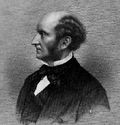
 This duty having been performed, my principal occupation for the next two years was on subjects not political. The publication of Mr. Austin’s Lectures on Jurisprudence after his decease, gave me an opportunity of paying a deserved tribute to his memory, and at the same time expressing some thoughts on a subject on which, in my old days of Benthamism, I had bestowed much study. But the chief product of those years was the Examination of Sir William Hamilton’s Philosophy. His Lectures, published in 1860 and 1861, I had read towards the end of the latter year, with a half-formed intention of giving an account of them in a Review, but I soon found that this would be idle, and that justice could not be done to the subject in less than a volume. I had then to consider whether it would be advisable that I myself should attempt such a performance. On consideration, there seemed to be strong reasons for doing so. I was greatly disappointed with the Lectures. I read them, certainly, with no prejudice against Sir W. Hamilton. I had up to that time deferred the study of his Notes to Reid on account of their unfinished state, but I had not neglected his “Discussions in Philosophy;” and though I knew that his general mode of treating the facts of mental philosophy differed from that of which I most approved, yet his vigorous polemic against the later Transcendentalists, and his strenuous assertion of some important principles, especially the Relativity of human knowledge, gave me many points of sympathy with his opinions, and made me think that genuine psychology had considerably more to gain than to lose by his authority and reputation. His Lectures and the Dissertations on Reid dispelled this illusion: and even the Discussions, read by the light which these throw on them, lost much of their value. I found that the points of apparent agreement between his opinions and mine were more verbal than real; that the important philosophical principles which I had thought he recognised, were so explained away by him as to mean little or nothing, or were continually lost sight of, and doctrines entirely inconsistent with them were taught in nearly every part of his philosophical writings. My estimation of him was therefore so far altered, that instead of regarding him as occupying a kind of intermediate position between the two rival philosophies, holding some of the principles of both, and supplying to both powerful weapons of attack and defence, I now looked upon him as one of the pillars, and in this country from his high philosophical reputation the chief pillar, of that one of the two which seemed to me to be erroneous.
Note from KBJ: Is there someone whose thought you once admired but came to think erroneous and therefore dangerous? I once thought highly of Ronald Dworkin, the legal and political philosopher. I even wrote about his work in my Ph.D. dissertation. But over the years, I have to come to view him as a propagandist. He is relentless ( to quote Maimon Schwarzschild) in his "spin." He caricatures views opposed to his; he conflates concepts (liberty and equality, for example) when it suits his convenience to do so; he makes unfair attacks on judges (or prospective judges, such as Robert Bork, Clarence Thomas, JohnRoberts, and Samuel Alito) who endorse jurisprudential theories at odds with his own; and he refuses to acknowledge that he was wrong about anything, when in fact he has been wrong about a great many things. His legal philosophy is at least interesting, even if one rejects it; his political philosophy, in which he defends egalitarianism, is rotten.

