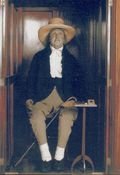
 Jurisprudence is a fictitious entity: nor can any meaning be found for the word, but by placing it in company with some word that shall be significative of a real entity. To know what is meant by jurisprudence, we must know, for example, what is meant by a book of jurisprudence. A book of jurisprudence can have but one or the other of two objects: 1. To ascertain what the law is: 2. to ascertain what it ought to be. In the former case it may be styled a book of expository jurisprudence; in the latter, a book of censorial jurisprudence: or, in other words, a book on the art of legislation.
(Jeremy Bentham, An Introduction to the Principles of Morals and Legislation, ed. J. H. Burns and H. L. A. Hart, in The Collected Works of Jeremy Bentham, ed. F. Rosen and Philip Schofield [Oxford: Clarendon Press, 1996], chap. 17, sec. 21, pp. 293-4 [italics in original; footnote omitted] [book first published in 1789])
Note from KBJ: Bentham's terminology, here as in so many other places, did not catch on. Today, jurisprudence is divided into two types: positive (Bentham's "expository") and normative (Bentham's "censorial"). A positive theory of rape, for example, is an attempt to reconstruct the law of rape. Its aim is elucidation. A normative theory of rape is an attempt to change the law of rape. Its aim is transformation. In pithier language, a positive theory of X is an attempt to get X right, whereas a normative theory of X is an attempt to set X right. Before criticizing a theory, you should take pains to understand what sort of theory it is. Several years ago, I published an essay entitled "A Theory of Rape." In it, I proposed to reconceive rape as coercion (rather than, say, as the absence of consent). At least two philosophers, Antony Duff and David Archard, mistook my theory for a positive theory, which means their criticisms missed the mark. Duff, for example, said in a review of my book (of which my essay was but one chapter) that I was "wrong." I explained to him that I can't be wrong if I'm not trying to be right. Either he did not grasp the point, in which case his intelligence is called into question, or he was hell-bent on saying bad things about me, in which case his moral character is called into question. I suspect the latter.

