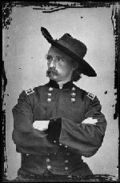
 If you love the American West or its history (or both), as I do, you'll enjoy reading Evan S. Connell's book Son of the Morning Star. This book, which took Connell four years to write, was published in 1984 by North Point Press in San Francisco. Apparently, Connell had trouble finding a publisher for the book, though he was, by that time, a prominent novelist. It may have been thought that nothing new or interesting could be said about George Armstrong Custer (1839-1876) or the Battle of the Little Bighorn, so much having been written in the previous 108 years. This was a mistake. Connell's book was a great success, both as a book and as a made-for-television movie (starring Gary Cole and Rosanna Arquette). The book is still in print. I purchased it in cloth (hardback) on 21 May 1985, not long after it was published. Today I finished reading it. How funny is it that the book sat on my shelf in four apartments or houses for a period of more than 30 years before I read it?
The book is hardly a celebration of Custer either as man or as military officer. But it's not a mindless indictment, either, as so many books about Custer seem to be. Connell simply tells the story, from beginning to end. Actually, that's misleading, because the thing that strikes you immediately about the book is that it's not linear. Connell begins with the discovery, by white soldiers, of the bodies of Custer and his men and horses on a sun-baked hillside in southeastern Montana. From there it winds around and around, as if by free association, until every aspect of the event has been covered. We learn everything from how Indian arrows were made to how the Indians and soldiers were dressed on 25 June 1876 to what Custer said to his wife Libby the last time they saw each other to what the battlefield looks like today (or rather, in the early 1980s). The cliché is that a particular book is so interesting that it can't be put down. It's not a cliché in this case. I did, however, limit myself to 10 pages of reading per day, since I have other things to read and do. There were many days in which I wanted to keep going after I reached the 10th page, but I resisted the temptation in order to prolong the joy.
I must admit that the book has given me a fuller understanding of Custer. Like every other human being, past or present, he was complicated. He loved his wife, his brothers, and his dogs, but was occasionally cruel (sometimes inexplicably and infuriatingly so) to the soldiers under his command, to his fellow officers, and to Indian dogs and ponies; he was outgoing and withdrawn by turns; he was a man of action but also of contemplation; at West Point, he finished last in his class, but he read widely and wrote continuously and well; he was at home both in New York City, enjoying an opera or a play, and in the wide-open spaces of Kansas, Texas, or Montana; he was cultured and crude, disciplined and impetuous, modest and vain, loyal and disloyal. By all accounts, he experienced every human emotion, from fear to anger to love to guilt to pity to joy to hatred. If I erred, it was in thinking too highly of Custer. I now have (I think) a more balanced view of him and of his times. I plan to read many more books about Custer during the years I have available. I have at least one more visit to the battlefield in me, having been there three times (in 1964, 1989, and 2014). Who knows? I may even contribute to the literature. One would think that there is nothing left to say, but that's what people thought in 1984 when Connell published his book. I, for one, am glad he persisted.
Addendum: Robert M. Utley, who has written a great deal about Custer and knows the man as well as anyone, wrote the following in 2004:
Although I resented the best-sellerdom of Evan Connell's Son of the Morning Star, which captured the public in ways I still fail to comprehend, George Armstrong Custer had been much kinder to my reputation and bank account than the Lincoln County warriors.
How Utley could fail to comprehend the success of Connell's book is mind-boggling. The book is riveting! It is written with a novelist's eye for detail, not an historian's eye for structure or grand narrative. If you read the first page of Connell's book, you will not want to put it down. Try it and see.

