 Moral theories are standardly presented as falling into three basic types, centring respectively on consequences, rights, and virtues. The first are unsurprisingly called 'consequentialist', and the last 'virtue' theories. The second are often called 'deontological', which means that they are centred on duty or obligation, but this is a cross-classification, since consequentialist theories also give prominence to an obligation, that of bringing about the best consequences. In terms of obligations, the difference is rather that pure consequentialist theories present only one basic obligation, while the second type of theory has many. But a more distinctive mark of difference is to be found in the idea of a right: the second type of theory grounds many of an agent's obligations in the rights of others to expect certain behaviour from that agent, a kind of consideration that utilitarians and other consequentialists regard as at best derivative and at worst totally spurious. (Bentham, the founder of utilitarianism, famously called rights 'nonsense on stilts'.)
(Bernard Williams, "Ethics," chap. 10 in Philosophy: A Guide Through the Subject, ed. A. C. Grayling [New York: Oxford University Press, 1995], 545-82, at 551 [italics in original])
Note from KBJ: As a piece of scholarship, this is disgraceful. Here is an exhaustive and exclusive taxonomy of rights:
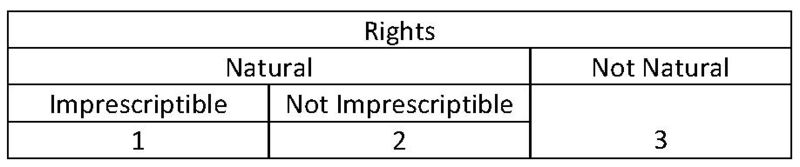
As the taxonomy shows, a right is either natural or not, and a natural right is either imprescriptible (i.e., inalienable) or not. Jeremy Bentham (1748-1832) described natural rights (categories 1 and 2) as "simple nonsense" and imprescriptible natural rights (category 1) as "nonsense upon stilts." (See page 5 of this essay.) He neither said not believed that rights (categories 1, 2, and 3) are nonsense, much less nonsense upon stilts. Legal rights, in his view, are perfectly intelligible. Bernard Williams is one of those philosophers who wrote too much, and, as a result, sloppily.

