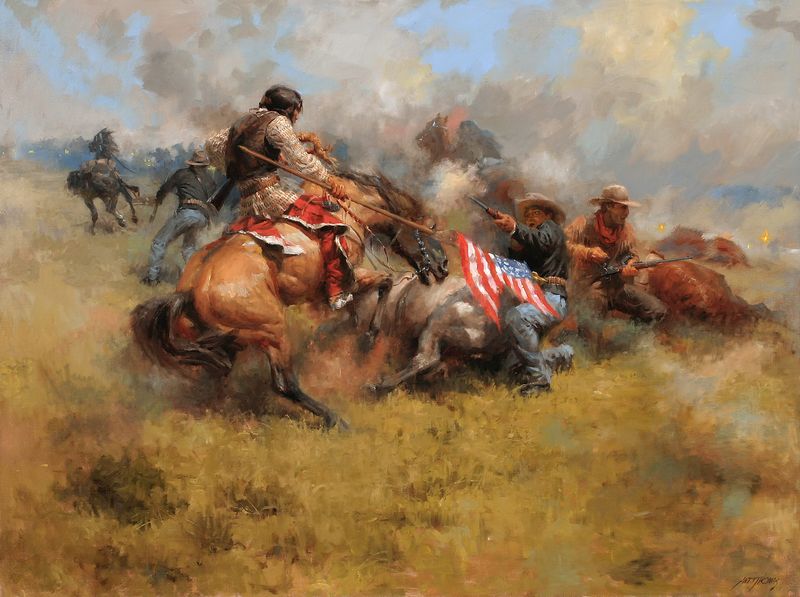
Today is the 140th anniversary of the Battle of the Little Bighorn, in which Lieutenant Colonel George Armstrong Custer (1839-1876) and more than 250 officers and soldiers of the Seventh Cavalry were killed by a combined force of Sioux and Cheyenne Indians. It so happens that I finished reading Custer's book My Life on the Plains: or, Personal Experiences with Indians (1874; reprint 1962) yesterday. (I began reading it on 31 May, in Scotland.) If you haven't read this book and are at all interested in the American West, Indians, or military history, you should read it. I'm a good writer (if I may be so bold as to say so), but I'm not half as good as Custer was. Custer's stories are not only well-written; they're spellbinding. If you want to see what I mean, read pages 201 to 219 of this book, which is available on Google Books for free. It's Custer's account of a battle with the Sioux Indians on the Yellowstone River in the summer of 1873, while he was providing security to a surveying expedition. By the way, I found my dog Autie on the street three years ago today. He was skin and bones. I took him in and today he is healthy and happy at 93 pounds! I named him after Custer, whose youthful nickname was "Autie" (for "Armstrong").
Addendum: Custer was a Brevet (temporary) General during the Civil War, which is why he is sometimes referred to as "General Custer." When the war ended, his rank reverted to Lieutenant Colonel.
Addendum 2: There is little doubt in my mind that, had he survived the Indian wars, Custer would have been elected president of the United States. He was ambitious; he was intensely political; he had charisma; he was a student of history; he was far more intelligent than most of his peers; he was literate and cultured; and, perhaps most importantly (then as now), he was adept at self-promotion. His wife Elizabeth ("Libbie") (1842-1933) would have made an elegant and gracious First Lady.

