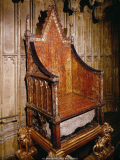
 In accordance with the custom of his ancestors a King of Scots was not crowned at the beginning of his reign, but 'set upon the stone' which, though it came to be at Scone, was alleged to have accompanied the Scots in all their mythical journeyings. The stone was sometimes called the 'Fatal Stone' or the 'Stone of Destiny'; a prophecy recorded in Latin by the first formal historian of Scotland foretold that 'wherever the stone should rest a King of Scots would reign', and James VI was crowned King of England on 25 July 1603 in Westminster Abbey, sitting on 'the stone'. One legend, told by an English chronicler, made it 'Jacob's Pillow', another made it 'Columba's Pillow', but the standard Scots tradition brought it with Gaythelus to Spain and thence to Scotland by way of Ireland. Some accounts gave it homes at Iona, Dunstaffnage, and Dunkeld before it came to Scone, and it may well have come into Pictland after Kenneth MacAlpin mounted the Pictish throne.
The old stories generally described it as of marble, and in the shape of a chair, but the stone now in Westminster Abbey is of coarse-grained sandstone fitted at each end with iron staples and rings, arrangements for carrying it, which may have been added by Edward I. The stone may at first have been a fixture—the stone of Dunadd is still in situ and it stood for permanence—standing or sitting upon it the new ruler formally assumed the power and the obligations of his predecessor. Latterly it was moveable, as appears from the full account of the coronation of young Alexander III in 1249. The stone was brought into the churchyard, the boy of seven was set upon it and invested with royal robes, then the Lyon King of arms hailed him in Gaelic as Alexander, son of Alexander, son of William, son of Henry, and so up the long pedigree to Gaythelus himself. There is no mention of a crown, and a contemporary Norwegian source, Haakon Haakonson's saga, specifically asserts that the Scots kings were not crowned. One reason for this may have been that the English monarchs did not wish their northern neighbour to hold a sacrosanct office. They prevented the Pope from acceding to Alexander II's request that he should be crowned by a representative of Rome, and it was not until 1329, when Scotland had already asserted her independence, that Pope John XXII formally authorized the unction and coronation of a Scottish king.
(J. D. Mackie, A History of Scotland, 2d ed. [New York: Dorset Press, 1978], 47-8)
Note from KBJ: Katherine and I saw a replica of the Stone of Destiny on the grounds of Scone Palace in Perth. Earlier, we saw the Stone itself (among the Crown Jewels) in Edinburgh Castle. I will post images in due course.


