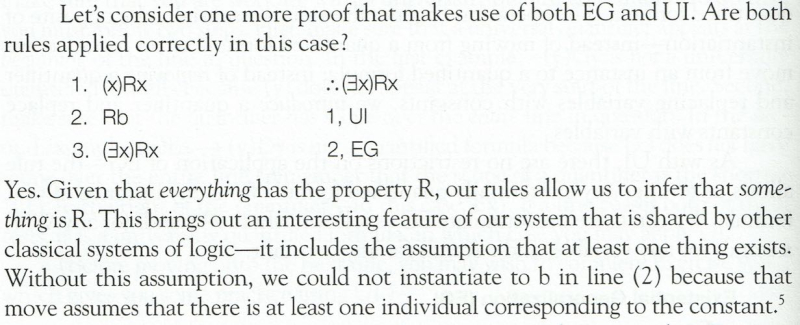
This quotation (click to enlarge) is from Frances Howard-Snyder, Daniel Howard-Snyder, and Ryan Wasserman, The Power of Logic, 5th ed. (New York: McGraw-Hill, 2013), 446. Just as the syllogism AAI-3 is conditionally valid, so is the inference from (x)Rx to (∃x)Rx. The condition for the first inference is that at least one member of the class denoted by the middle term exists. The condition for the second inference is that at least one thing exists. Without these assumptions of existence, the inferences are invalid. With the assumptions, the inferences are valid.
Unconditional validity is different. The syllogism IAI-3 is unconditionally valid, meaning that it is valid even if none of the three classes has members. The inference from (x)Rx to ~(∃x)~Rx is unconditionally valid, meaning that it is valid even if nothing exists, i.e., even if the universe is empty.
As you can see, the assumption of existence is crucially important. It determines whether the inferences are valid or invalid. It's unfortunate (indeed, criminal) that so many logic textbooks fail to mention the second assumption, to the effect that at least one thing exists. The book cited is one of the good ones, as is Stan Baronett's Logic, 3d ed. (New York: Oxford University Press, 2016), 473. Neither Copi nor Hurley mentions the assumption, to their discredit.

