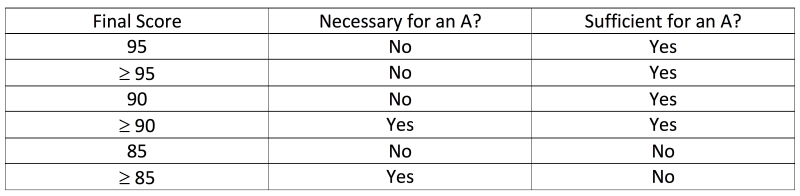
Here (click to enlarge) is how I explain the concepts of necessary and sufficient conditions to my Ethics students. They know (because I told them as much on the first day of class) that I assign grades on the basis of a 10% scale. Anyone with a final score of 90 or higher receives an A in the course; anyone with a final score in the 80s receives a B; and so on.
I draw a diagram such as the above on the board, without the "Yes's" and "No's." I ask the students to fill in the blanks with me. "Is receiving a final score of exactly 95 necessary for an A?" I ask. They say no. "Is receiving a final score of exactly 95 sufficient (i.e., enough) for an A?" They say yes. By the time we get the diagram filled in, they begin to understand the concepts. They can see that a final score of exactly 95 is sufficient but not necessary for an A. They can see that a final score of exactly 85 is neither necessary nor sufficient for an A. They can see that a final score of at least 85 is necessary but not sufficient for an A. They can see that a final score of at least 90 is both necessary and sufficient for an A. This is because I defined "A" as receiving a final score of at least 90.
Having done this preliminary work, I ask the students to help me compile a list of necessary conditions for being a bachelor. I write "x is a bachelor only if:" on the board and then invite suggestions. Someone will say "being a male," so I write "1. x is a male." After each numbered item is added, I ask whether the necessary conditions we have listed so far are jointly sufficient for being a bachelor. Once we get a list of jointly sufficient conditions, we have a set of individually necessary and jointly sufficient conditions for being a bachelor. That is to say, we have the essence of bachelorhood. In case you're wondering, a bachelor is not a never-married male (as most dictionaries say) but a never-married but eligible-to-be-married male. (I assume that only adults are eligible to be married, so there is no need to add "x is an adult" to the list.) The Pope is a never-married male, and indeed a never-married adult male, but it sounds odd to describe him as a bachelor. Why? Because he's not eligible to be married. He's not "on the market." I don't want to be dogmatic about this example; reasonable people can and do disagree about the concept of bachelorhood. It's surprisingly complicated.
Once the students understand the concepts of necessary and sufficient conditions, they are in a position to understand normative ethical theories, each of which purports to state the necessary and sufficient conditions for rightness. Act Utilitarianism, for example, says that for all acts x, x is right if and only if x maximizes (overall) utility. This says that maximization of utility is both necessary and sufficient for rightness. Put differently, all and only acts that maximize utility are right acts. If an act maximizes utility, then it is right. If an act does not maximize utility, then it is not right (i.e., it is wrong).
Each of the seven normative ethical theories that I cover in my Ethics course has its own set of necessary and sufficient conditions for rightness. Each theory, in other words, sorts acts into the categories "right" and "wrong," but they sort in different ways. Theories are sorting devices. If you think a particular theory sorts acts incorrectly (either by classifying a right act as wrong or a wrong act as right), then you have a reason to reject that theory. It may be that no theory sorts acts exactly as you think proper, so you may have to choose the theory that comes closest to sorting acts correctly. (By "correctly," I mean in accordance with your intuitions or considered judgments.)
In case you're wondering why anyone would want to accept, endorse, or subscribe to a normative ethical theory, the answer is twofold. First, the theory systematizes what were previously unconnected intuitions or judgments. System is good. Second, the theory provides guidance for new or unfamiliar cases. If the theory systematizes most of your intuitions or judgments, then you have reason to accept its verdict on acts about which you have no intuitions or judgments. It is in this sense that normative ethical theories are action-guiding. They provide norms by which to guide judgment and action.

