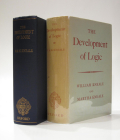
 Since logic is not simply valid argument but the reflection upon principles of validity, it will arise naturally only when there is already a considerable body of inferential or argumentative material to hand. Not every type of discourse provokes logical inquiry. Pure story-telling or literary discourse, for example, does not provide a sufficient amount of argumentative material. It is those types of discourse or inquiry in which proof is sought or demanded that naturally give rise to logical investigation; for to prove a proposition is to infer it validly from true premisses. The conditions of proof are two: true premisses, or starting-points, and valid arguments.
(William Kneale and Martha Kneale, The Development of Logic [Oxford: Clarendon Press, 1962; paperback ed., 1984], 1 [italics in original])
Note from KBJ: This is a thin conception of proof. Most contemporary logicians would call a valid argument with true premises a sound argument. A proof is a sound argument all of whose premises are known. In other words, proof is an epistemological concept.

