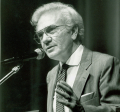
 During the 1960s, I met frequently with students who said that we had nothing in common, because I was over thirty and I was running a corrupt university. I was fascinated that they kept insisting we had nothing in common. And I was troubled that we have educated students to understand individualism but have not reminded them of our essential connections. We affirm the differences, but fail to capture the commonalities. And in the absence of larger loyalties, we're settling for little loyalties. Students are hunkering down in their separate interests, failing to find the relationships that bind.
This led me to try to identify the human commonalities that might be an organizing framework for a larger, more integrative course of study. I finally concluded that there are eight universal experiences that bind us all together—all cultures, all people on the planet—and these might be the means by which our students could discover the fabric of integration. First, we are all bound together by the imperative of birth and growth and death, and at the core of every curriculum should be a study of the life cycle—the miracle of our own existence, the majesty of conception, the inevitability of death. Second, we are all connected through our ability to use symbols, as I've discussed. Third, every human being on the planet responds to the aesthetic. Fourth, we are all members of groups and institutions, even though they differ from one culture to another. Fifth, there is a natural world, "an enormous imponderable system of life in which we're embedded," as Lewis Thomas said, "as working parts." To understand ecology and our place in it is absolutely crucial. Sixth, we all can recall the past and anticipate the future, a marvelous capacity that we do not exercise well these days. Seventh, we all engage in producing and consuming, though far too many people in this country are preoccupied with consumption and have very little understanding of production. And finally, we all search for ultimate meaning and purpose in our lives. It's here that religion plays a central role in our intellectual quest.
(Ernest Boyer, "Teaching Religion in the Public Schools and Elsewhere," Journal of the American Academy of Religion 60 [autumn 1992]: 515-24, at 521-2 [boldface added])
Note from KBJ: Identity politics had yet to rear its ugly head. People are divided more than ever—by race, sex, age, sexuality (sexual identity), religion, ethnicity, and nationality, though not (yet) by handedness.

