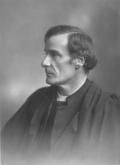
 Moral arguments for theism were put forward before Kant asserted the primacy of the practical reason; but they generally held a subsidiary place. From Kant's day to our own they have occupied a dominant position in theistic systems. It is fitting, therefore, to begin an examination of them by recalling the more enduring part of the line of reasoning which led Kant to conclude that the deliverances of our moral faculty afford satisfactory ground for belief in a Divine Being. More than this Kant did not claim to have shewn: he did not intend to provide a theistic proof. He merely argues that God, a regulative idea for the theoretical reason, is a postulate for the practical reason: if the moral order of the world (as Kant conceived it) is to stand, and what ought to be is to be, God must exist.
(F. R. Tennant, Philosophical Theology, vol. 2, The World, the Soul, and God [Cambridge: Cambridge University Press, 1930], 96 [italics in original])

