 Besides, the divine law is the measure or test of positive law and morality: or (changing the phrase) law and morality, in so far as they are what they ought to be, conform, or are not repugnant, to the law of God. Consequently, an all-important object of the science of ethics (or, borrowing the language of Bentham, 'the science of deontology') is to determine the nature of the index to the tacit commands of the Deity, or the nature of the signs or proofs through which those commands may be known.—I mean by 'the science of ethics' (or by 'the science of deontology'), the science of law and morality as they respectively ought to be: or (changing the phrase), the science of law and morality as they respectively must be if they conform to their measure or test. That department of the science of ethics, which is concerned especially with positive law as it ought to be, is styled the science of legislation: that department of the science of ethics, which is concerned especially with positive morality as it ought to be, has hardly gotten a name perfectly appropriate and distinctive.—Now, though the science of legislation (or of positive law as it ought to be) is not the science of jurisprudence (or of positive law as it is), still the sciences are connected by numerous and indissoluble ties. Since, then, the nature of the index to the tacit command of the Deity is an all-important object of the science of legislation, it is a fit and important object of the kindred science of jurisprudence.
(John Austin, The Province of Jurisprudence Determined, in The Province of Jurisprudence Determined and The Uses of the Study of Jurisprudence [Indianapolis: Hackett Publishing Company, 1998 (book first published in 1832)], 6-7 [italics in original])
Addendum: Here is Austin's taxonomy, pieced together from this and other sources (click to enlarge):
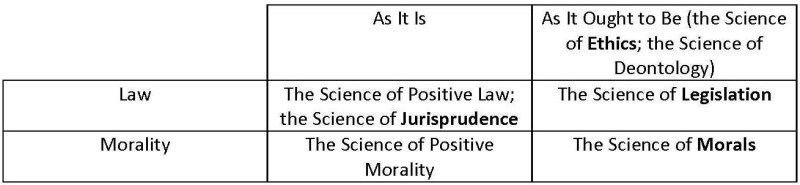
Divine law (some of which is revealed and some of which is unrevealed) is the "measure or test" of both law and morality. Note that in his great work An Introduction to the Principles of Morals and Legislation (1789), Jeremy Bentham (1748-1832) was concerned only with law and morality as they ought to be. Austin's concern was law as it is. In modern terminology, Bentham was concerned with normative jurisprudence and normative ethics; Austin was concerned with analytic(al) jurisprudence. One more comment: Bentham almost certainly rejected Austin's theism. Both were, however, utilitarians. Austin viewed the Principle of Utility as an index of God's (unrevealed) will. As he put it:
Inasmuch as the goodness of God is boundless and impartial, he designs the greatest happiness of all his sentient creatures: he wills that the aggregate of their enjoyments shall find no nearer limit than that which is inevitably set to it by their finite and imperfect nature. From the probable effects of our actions on the greatest happiness of all, or from the tendencies of human actions to increase or diminish that aggregate, we may infer the laws which he has given, but has not expressed or revealed. (Province, 38)
Bentham would have used Ockham's Razor to slice God away, leaving only the Principle of Utility as the "measure or test" of law and morality.

