Here.
-
Dilbert
–––––––
-
To the Editor:
Re “Is Warfare in Our Bones?” (editorial, Jan. 24):
The military theorist B. H. Liddell Hart taught, “If you want peace, understand war.” The recent discovery of 10,000-year-old skeletons in northern Kenya, with every sign of being killed in battle, has revived the debate over the origins of warfare.
There is other archaeological evidence of humans killing humans, including Native Americans long before Europeans brought guns or horses to this continent. We are not only a violent animal, but also a uniquely violent animal.
Only a few mammalian species systematically and deliberately kill their own species. Bears don’t do this, tigers don’t, cats and dogs don’t, but chimpanzees, hyenas and—without any shadow of doubt—human beings do. It is a predisposition that evolved among these intelligent and highly social animals because the winning side gained more resources and, ultimately, more of their progeny survived—the basic metric of Darwinian evolution.
The good news is that we don’t have to live out our inherited predispositions of team aggression against our fellow human beings. While ISIS expresses the default behavior for much of human history, the huge majority of the 7.4 billion people in the world today are not killing their neighbors.
If the 10,000-year-old skeletons from Kenya can help us understand that the origins of warfare are indeed in our bones, then we can begin to ask the correct question—not why wars break out, but why does peace break out?
MALCOLM POTTS
Berkeley, Calif.
The writer, a professor of public health at the University of California, Berkeley, is co-author of “Sex and War: How Biology Explains Warfare and Terrorism and Offers a Path to Safer World.”
Note from KBJ: What is the point of this letter? It looks like a book promotion.
From Today’s New York Times
–––––––
-
Here.
Ten Years Ago Today in This Blog
–––––––
-
Here.
Dilbert
–––––––
-
 Suppose a government has two available justifications for a contemplated act. If it chooses to justify its behavior under one of them, it does not follow that the act cannot be justified under the rationale it did not choose to invoke. The justification is still valid, and if it applies it may justify the act even if the government did not invoke it.
(Fernando R. Tesón, "Ending Tyranny in Iraq," Ethics & International Affairs 19 [September 2005]: 1-20, at 4 [italics in original; footnote omitted])
Note from KBJ: Some of you may recall that I made this point many times in this blog, back when the war in Iraq was in the news.
-
Here.
Man’s Best Friend
–––––––
-
Now Playing
–––––––
-
To the Editor:
The Times, in its sweeping editorial endorsement of Hillary Clinton and its brushoff of Bernie Sanders’s candidacy, does not reflect its own newspaper reporting about her actual record.
Domestically, Mrs. Clinton supported the deregulation of Wall Street. As senator, she failed to face up to the financial industry’s worsening abuses that took down the economy in 2008. She waited until April 2014 to support the modest, staggered $10.10 per hour minimum wage bill of her Democratic colleagues in Congress.
Mrs. Clinton voted for the disastrous war in Iraq. Later, she pressed, against the opposition of Defense Secretary Robert M. Gates, for an unauthorized war on Libya that has led to chaotic violence there and in neighboring countries.
Being such a war hawk and Wall Street supporter hardly qualifies for the “confidence and enthusiasm” The Times has bestowed upon her.
RALPH NADER
Washington
Note from KBJ: Hillary Clinton wouldn't even be in contention if it weren't for the Vagina-American vote.
From Today’s New York Times
–––––––
-
 When Lance enters a situation, he has a habit of shaking things up, raising the temperature of the room. I've come to believe that it's not something he can help: it's as though he's allergic to calm. It's almost like he's not comfortable unless there's a sense of discomfort, of intense and decisive action. He had a knack for seeking out weaknesses, for putting his finger on something that needs to be improved. He constantly judged everything: what kind of cereal we should have at the training table, where we should train, what kind of water bottle tops were best, which soigneur gave the best massage, where you could get the best bread, how to make espresso, what tech stock was going to take off—you name it, he knew it, and told you in no uncertain terms. Things he admired would earn an appreciative nod; things he didn't like would be dismissed with a puff of air through the lips: phffffff (a habit Lance seemed to have picked up from the Europeans). There were no gray areas; things were either amazing or awful. We used to joke that the one word guaranteed to piss Lance off was "maybe."
What Lance hated most of all, though, were choads. I'm not sure where the word came from—probably "chump" plus "toad"—but it meant what it sounded like. Choads were whiners, weaklings, guys who couldn't hack it or—worse—couldn't hack it and then complained. If you made a habit of being late or disorganized, you were a choad. If you weren't strong enough to ride in bad weather, or if you gave excuses for your performance, you were a choad. If you were a wheelsucker (someone who always rides in the slipstream of others), you were a choad. And once you were a choad, there was no going back.
(Tyler Hamilton and Daniel Coyle, The Secret Race: Inside the Hidden World of the Tour de France [New York: Bantam Books Trade Paperbacks, 2013], 64)
-
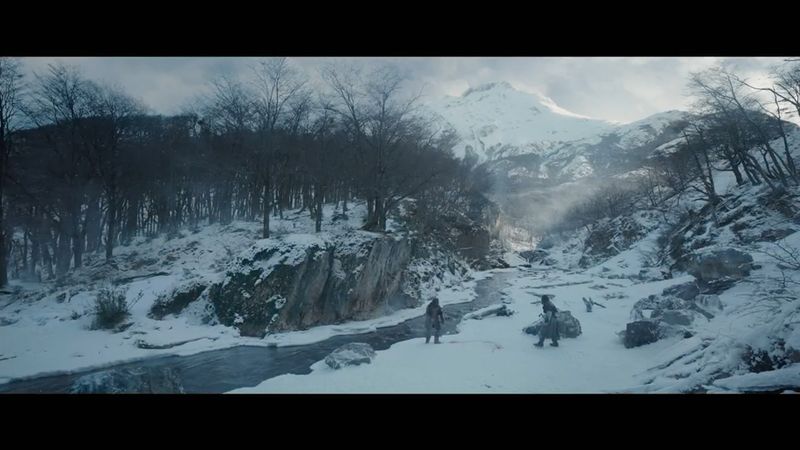
As regular readers of this blog know, I usually have no trouble finding words to express my thoughts or feelings, but I'm pretty much speechless after watching The Revenant (2015) at the theater yesterday. I've rarely seen anything as beautiful or affecting. The movie is about mountain man Hugh Glass, who was horribly maimed by a grizzly bear and left for dead by two comrades, John Fitzgerald and the youthful Jim Bridger. Glass survived the ordeal and made his way back to civilization (or what passed for the same in the West) to exact retribution on the men who abandoned him.
My only complaint about the movie is that Glass was given an Indian wife and half-breed child in the movie, even though neither character figured in the novel on which the movie is based. The child is murdered by Fitzgerald while Glass is incapacitated. I'm pretty sure the screenwriter wanted to make Fitzgerald detestable so as to make it more satisfying for the audience when Glass catches up to him. (The image in this post shows their deadly confrontation near the end of the movie. Click to enlarge.) It would have been more subtle (and therefore more interesting) if all Fitzgerald had done was abandon Glass. The question would then have arisen: Is that enough to exact retribution? Does being abandoned justify killing the abandoner? I blame the unsubtlety of American audiences for the moralistic overkill.
I can't wait for the DVD to be released. I plan to watch the movie at least one more time, and perhaps several times before I die. I rank it with Jeremiah Johnson (1972) as one of the greatest films ever made.
Here is the trailer.
Film
–––––––

