Here.
-
Dilbert
–––––––
-
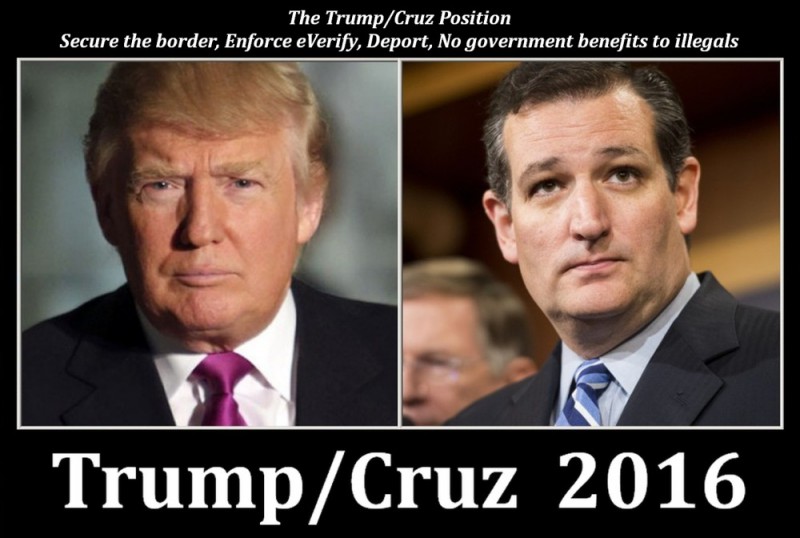
I'm with Jeffrey Lord: Trump/Cruz in 2016.
Politics
–––––––
-
To the Editor:
Nicholas Kristof’s apologia for gun ownership doesn’t address one reason people like me want more gun control, not just more gun safety. Allowing people to walk around with guns infringes on my freedom: the freedom not to live in fear of gun-toting hotheads who turn a simple unpleasant encounter with another person into a deadly one, like a man shooting someone in a movie theater in Florida in 2014 because the young man threw what turned out to be popcorn at him.
Or another man shooting some children in a parking lot because their music was too loud. Or a neighborhood-watch volunteer fatally shooting a black teenager walking in his neighborhood at night, as in the Trayvon Martin case.
And it infringes on my freedom not to have gun-toting vigilantes take over my federal lands. Sound familiar? Here’s the true inconvenient fact: the gun craze erodes our freedom to live without fear in a way crime statistics will never capture.
SHELLY B. KULWIN
Chicago
Note from KBJ: If Shelly Kulwin is afraid of being killed with a gun, then she should want more, not fewer, law-abiding citizens with guns around her. Does she want only the criminals to have guns? Talk about irrational!
From Today’s New York Times
–––––––
-

The Mackinac Bridge from Shepler's Ferry, with breakwall and birds in the foreground. Click to enlarge.
Michigan #33
–––––––
-
Here.
Ten Years Ago Today in This Blog
–––––––
-
Here.
Dilbert
–––––––
-
 Moral theories are standardly presented as falling into three basic types, centring respectively on consequences, rights, and virtues. The first are unsurprisingly called 'consequentialist', and the last 'virtue' theories. The second are often called 'deontological', which means that they are centred on duty or obligation, but this is a cross-classification, since consequentialist theories also give prominence to an obligation, that of bringing about the best consequences. In terms of obligations, the difference is rather that pure consequentialist theories present only one basic obligation, while the second type of theory has many. But a more distinctive mark of difference is to be found in the idea of a right: the second type of theory grounds many of an agent's obligations in the rights of others to expect certain behaviour from that agent, a kind of consideration that utilitarians and other consequentialists regard as at best derivative and at worst totally spurious. (Bentham, the founder of utilitarianism, famously called rights 'nonsense on stilts'.)
(Bernard Williams, "Ethics," chap. 10 in Philosophy: A Guide Through the Subject, ed. A. C. Grayling [New York: Oxford University Press, 1995], 545-82, at 551 [italics in original])
Note from KBJ: As a piece of scholarship, this is disgraceful. Here is an exhaustive and exclusive taxonomy of rights:
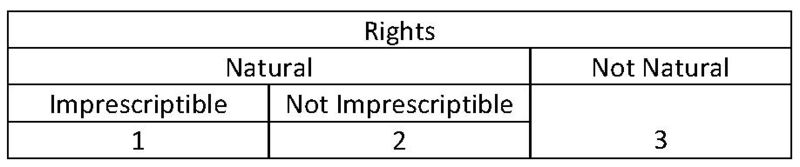
As the taxonomy shows, a right is either natural or not, and a natural right is either imprescriptible (i.e., inalienable) or not. Jeremy Bentham (1748-1832) described natural rights (categories 1 and 2) as "simple nonsense" and imprescriptible natural rights (category 1) as "nonsense upon stilts." (See page 5 of this essay.) He neither said not believed that rights (categories 1, 2, and 3) are nonsense, much less nonsense upon stilts. Legal rights, in his view, are perfectly intelligible. Bernard Williams is one of those philosophers who wrote too much, and, as a result, sloppily.
-
To the Editor:
I would like to thank Paul Krugman for clarifying his position on Hillary Clinton’s health care proposal. When, in the last debate, Mrs. Clinton stated that Mr. Krugman preferred her health care plan to Bernie Sanders’s, I thought I had to clean out my ears.
Now all is clear—as a Nobel Prize-winning economist, Mr. Krugman thinks that Mr. Sanders’s plan is superior to Mrs. Clinton’s. In his role as a political pundit, however, Mr. Krugman thinks that Mr. Sanders’s plan would not be feasible to get through Congress. So the best we can do is improve on the current law.
As an economist, Mr. Krugman has year after year been right in his judgments, and I put a lot of trust in them. But as a political pundit, his view has no more authority than that of any other talking head. Mrs. Clinton was disingenuous to cite Mr. Krugman’s support without making it clear that he was not offering an economic opinion.
BRETT L. GOLD
New York
Note from KBJ: This is precious. "Bush-Hatin' Paul" Krugman has been pontificating on politics, morality, law, military affairs, and every other subject for well over a decade. He has no expertise or authority in any of those areas. His economic expertise is technical in nature; it gives him no evaluative authority of any kind. It's good to see a Leftist acknowledge this. Where have you been, Brett Gold? When Krugman's interventions were to your liking, you remained silent. When he offers a political judgment with which you disagree, you wail.
From Today’s New York Times
–––––––
-
Young Lions (1990). This song was written (and sung) by the late David Bowie. Adrian Belew supplies the incredible guitar.
-
Ann Coulter nails it.

