Here's what I saw on the trail today (click to enlarge):

Undaunted, I waded across (both going and coming):
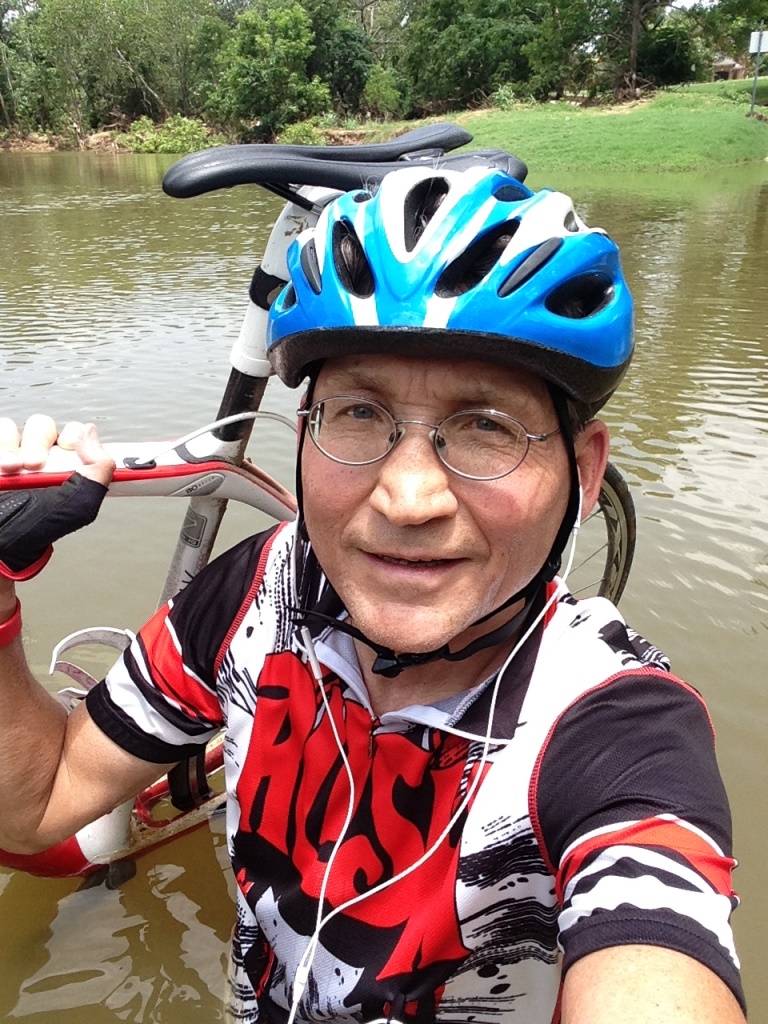
It's not just a ride; it's an adventure.
Here's what I saw on the trail today (click to enlarge):
Undaunted, I waded across (both going and coming):
It's not just a ride; it's an adventure.
–––––––
Here.
–––––––
Here.
–––––––
To the Editor:
Paul Greenberg tells us he’s tried to come up with a “seafood three-liner that would be as concise, elegant and free from exceptions” as the writer Michael Pollan’s maxim: “Eat food. Not too much. Mostly plants” (“Simple Rules for Seafood,” Sunday Review, June 14).
Seafood is complex, and that’s why Mr. Greenberg hasn’t been “entirely successful.” Perhaps it’s this complexity and the sources and methods he uses that challenge him so. His zeal to highlight his ideal seafood takes him on the wrong path.
For instance, he cites a Consumer Reports article about mercury in canned tuna but never mentions that the Food and Drug Administration criticized that report because it “overestimates the negative effects and overlooks the strong body of scientific evidence published in the last decade” about the benefits of fish.
Wallet cards and lists of fish to avoid have tried to dumb down seafood science for years. Perhaps a longer conversation about seafood’s nutritional importance is needed before we switch to CliffsNotes. Or Mr. Greenberg could adopt the simple approach of doctors’ three-word advice: “Eat more seafood.”
LYNSEE FOWLER
Communications Manager
National Fisheries Institute
McLean, Va.
–––––––
For the love of God, Barack Obama didn't use the word "nigger." He mentioned it. Have we lost our minds? There is as much difference between using a word and mentioning it as there is between using a hammer (to pound a nail, for instance) and talking about it ("This hammer cost me $12"). I'm writing a scholarly article entitled "'Nigger.'" This is precisely what it's about.
Addendum: Here are five uses of the word "nigger" (or "niggers"):
Here are five mentions of, or references to, the word "nigger":
Just so you know, I did not use the word "nigger" in this blog post. Not once. I did, however, mention it several times, which is to say that I referred to it or talked about it. How can we, as a society, get beyond racism if we can't talk about the words that offend, disparage, insult, or degrade (and how they do these things)? Using "N-word" or "n—–" rather than "nigger" is stupid and dishonest.
–––––––
–––––––
Here.
–––––––
Here.
–––––––
 Katherine and I went to the theater this afternoon to watch Jurassic World (2015). In 20 days, we watched all four Jurassic movies, in order. The fourth one was pretty good, but I got lost near the end when a large dinosaur was released. The humans acted as though the released dinosaur would fight the genetically modified dinosaur, which was wreaking havoc on the theme park, but I don't know why they thought it would. For all they knew, it would join the genetically modified dinosaur and make things worse for everyone. As if this weren't confusing enough, when the two dinosaurs were fighting, you couldn't tell which was which. It was absurd! These confusing aspects aside, I enjoyed the movie, but I think I've had enough dinosaurs for a while.
Here is the trailer.
–––––––
To the Editor:
As an African-American woman of similar physical appearance to Rachel Dolezal, I read about her with interest. Rather than offend, her story makes me question what would make a white girl want to be a member of a historically scorned group.
My parents were both light-skinned African-Americans. Growing up in Compton, Calif., in the black-is-beautiful era, I was ever conscious of my extremely light skin. That it offered me a certain freedom was a reality I fought long and hard to ignore. I could walk down a crowded street unnoticed even as my brown-skinned brother would cause the same people to cross the street.
It was not until I moved to a rural part of New York that I got a chance to really live in and experience white America. Sadly, in faculty lounges there was always a colleague weighing in on some issue of color with bigoted zeal, forgetting my race because of my light skin.
I don’t see any real pathology in Ms. Dolezal’s desire to live in a different skin. I only see questions that need addressing by everyone. What if she just got sick and tired of being the fly on the wall, hearing thoughtless racist comments made even more despicable by the assumption that all those with white skin feel the same way? Maybe the pathology in this story lies not with Ms. Dolezal but with a race-obsessed culture in which happiness is apparently only skin-deep.
GWEN DAVIS-FELDMAN
Cameron Mills, N.Y.
Note from KBJ: "What would make a white girl want to be a member of a historically scorned group"? Gee, I don't know. Could it be the fact that this "historically scorned group" is now privileged? The privileges include (1) being given preference at work and in institutions of higher education, (2) not being held accountable for one's actions, and (3) being able to accuse one's critics of being racist, bigoted, and prejudiced. Rachel Dolezal saw all this and wanted to get in on the action. Prediction: It's going to get much, much worse.
–––––––

