Rock and Roll Over (1976). The song was written by guitarist Paul Stanley but sung by drummer Peter Criss.
-
Kiss, “Hard Luck Woman” (1976)
–––––––
-
 This essay by English professor Robert Boyers is worth a few minutes of your time. Anyone who has been in academia for 20 years or more has noticed a profound change. What used to be an open environment for discussion and criticism has become a closed system of speech monitoring and thought control. What's worse, administrators often side with the creepy totalitarians who try to shut down expressions of ideas with which they disagree (or to which they take offense).
I agree with Boyers that this is "genuinely alarming." Professors have never been among society's bravest individuals. When confronted by angry students, they capitulate, even if they believe the students to be misguided. Some professors are secretly gleeful whenever students "take down" a conservative professor. I would remind these cowards that they might be next. Indeed, they deserve to be next.
Native Americans counted coup. (Click the inserted image.) Today, students—with the assistance of craven administrators and fellow-traveling professors—count coup.
Campus Totalitarians
–––––––
-
Propositional form X is logically equivalent to propositional form Y (i.e., X and Y are logically equivalent [to one another]) iff (1) it is impossible for X to be true while Y is false and (2) it is impossible for Y to be true while X is false. In other words, (1) X logically implies Y and (2) Y logically implies X.
Example from everyday life: 'x is taller than y' is logically equivalent to 'y is shorter than x'
Example from categorical logic: 'Some S are not P' is logically equivalent to 'Some nonP are not nonS' (this is contraposition of an 'O' proposition)
Example from propositional logic: 'p ﬤ q' is logically equivalent to 'p ﬤ (p • q)'
Example from predicate logic: '~(Ǝx)Øx' is logically equivalent to '(x)~Øx'
-
Here.
Ten Years Ago Today in This Blog
–––––––
-
Here.
Dilbert
–––––––
-
This picture (click to enlarge) was taken after today's 37-mile ride. Weather conditions were quite bad, with temperatures in the 30s, a stiff northerly wind, and spitting rain. As you can see, I was bundled up to ward off the chill. My goal for the year was 6,000 miles, but I ended up with 5,800. I lost three consecutive days of riding in the middle of December because of a crank problem on my bike. I averaged 15.89 miles per day this year, which is an average of 111.2 miles per week. This is my third-best year ever, in terms of mileage. (I've been riding since 1981, when I was 24 years old.) My two-year total is 12,088 miles. My cumulative total is 96,549.1 miles. Next year, I plan to go for the record, which is 6,288 miles. I ride; therefore I am.
Roto Ergo Sum
–––––––
-
Donald Trump is on his way to becoming our greatest president. Whoever woulda thunk it? I must admit, I once thought him a buffoon. It just goes to show how opinions can change.
Politics
–––––––
-
He’s arrogant, egotistical, vindictive, loony and a war-monger, and if he hadn’t received five deferments to avoid military service, you might believe I’m writing about Gen. George Armstrong Custer.
I consider Mr. Deferments, our current president, more unpatriotic than those taking a knee during the national anthem.
And the fact that our brave service members have to salute him is irony at its finest.
DON PALMIERI
Pine
-
Many reports of peaceful protests by Iranian citizens fed up with regime’s corruption & its squandering of the nation’s wealth to fund terrorism abroad. Iranian govt should respect their people’s rights, including right to express themselves. The world is watching! #IranProtests
— Donald J. Trump (@realDonaldTrump) December 30, 2017
Presidential Tweet
–––––––
-
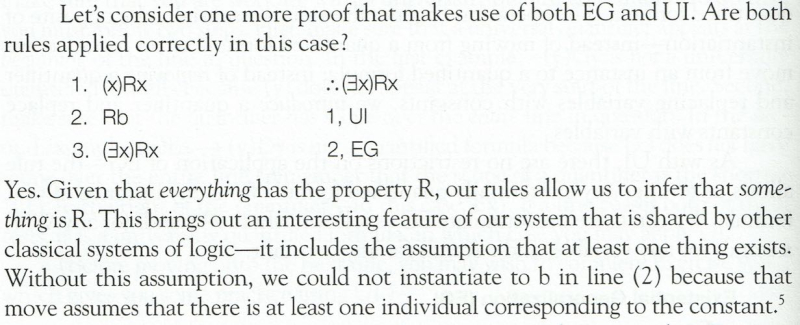
This quotation (click to enlarge) is from Frances Howard-Snyder, Daniel Howard-Snyder, and Ryan Wasserman, The Power of Logic, 5th ed. (New York: McGraw-Hill, 2013), 446. Just as the syllogism AAI-3 is conditionally valid, so is the inference from (x)Rx to (∃x)Rx. The condition for the first inference is that at least one member of the class denoted by the middle term exists. The condition for the second inference is that at least one thing exists. Without these assumptions of existence, the inferences are invalid. With the assumptions, the inferences are valid.
Unconditional validity is different. The syllogism IAI-3 is unconditionally valid, meaning that it is valid even if none of the three classes has members. The inference from (x)Rx to ~(∃x)~Rx is unconditionally valid, meaning that it is valid even if nothing exists, i.e., even if the universe is empty.
As you can see, the assumption of existence is crucially important. It determines whether the inferences are valid or invalid. It's unfortunate (indeed, criminal) that so many logic textbooks fail to mention the second assumption, to the effect that at least one thing exists. The book cited is one of the good ones, as is Stan Baronett's Logic, 3d ed. (New York: Oxford University Press, 2016), 473. Neither Copi nor Hurley mentions the assumption, to their discredit.

